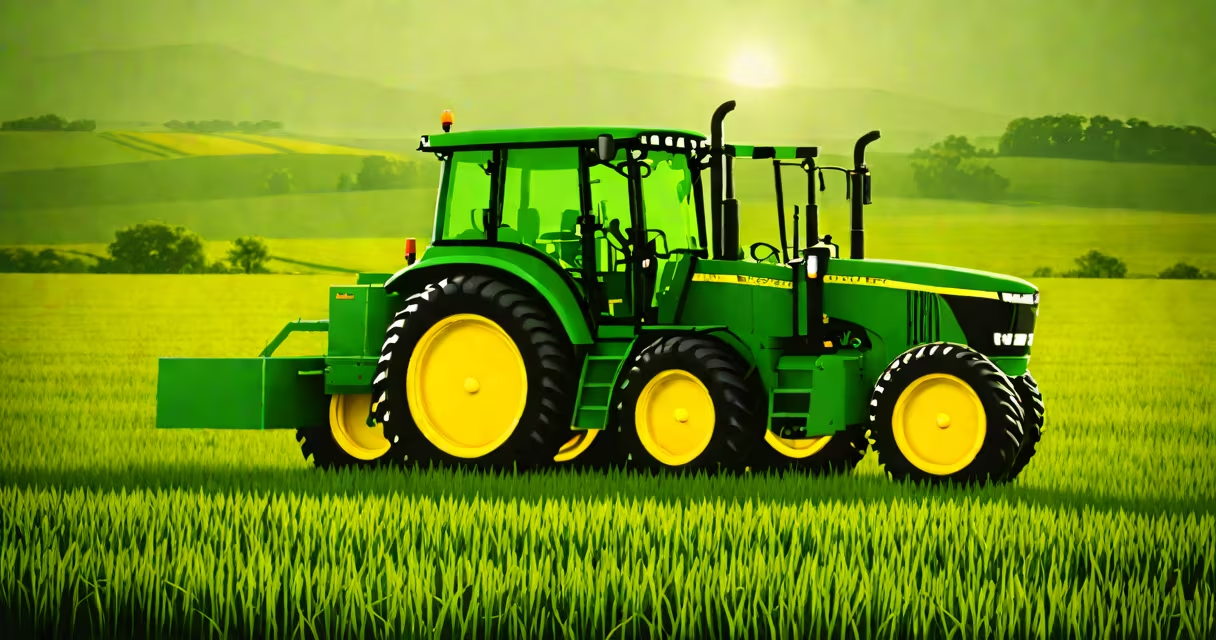
John Deere stock market refers to the publicly traded shares of Deere & Company (NYSE: DE), a U.S.-based manufacturer of agricultural and construction equipment. The company's stock trades under the ticker symbol DE and is part of the S&P 500 index. Its performance reflects global demand for farm machinery, commodity prices, and macroeconomic conditions affecting agriculture.
Deere & Company was founded in 1837 and went public in 1946. Its stock is listed on the New York Stock Exchange (NYSE). As of Q1 2024, the company had a market capitalization of approximately $168 billion, making it one of the largest industrial firms in the U.S. Investors track its stock for exposure to long-term trends in food production, land use, and automation in farming.
The stock is influenced by seasonal factors-agricultural equipment sales peak in spring and fall. This creates quarterly earnings patterns tied to planting and harvesting cycles. For example, in 2023, John Deere reported a 12% drop in revenue during Q3 due to lower equipment sales in North America, which caused the stock to fall 8% over two weeks.
When you buy John Deere stock, you purchase a share of ownership in Deere & Company. Shareholders receive dividends and have voting rights at annual meetings. The stock price fluctuates based on supply and demand in the market, driven by investor sentiment, earnings reports, and broader economic indicators.
Trading occurs on the NYSE during regular hours (9:30 AM to 4:00 PM Eastern Time). Prices are updated in real time through financial data providers like Bloomberg and Reuters. A single share of DE stock cost $187.42 on March 15, 2024, according to Yahoo Finance. The stock has a dividend yield of 1.4%, paid quarterly.
Market orders execute instantly at the current bid or ask price. Limit orders allow investors to set a maximum purchase price or minimum sale price. For example, an investor who places a limit order to buy DE at $180 will only execute if the price drops to that level.
Investors engage with John Deere stock through several mechanisms:
| Type | Description | Example |
|---|---|---|
| Long-term holding | Buying shares to benefit from growth over years | Investor bought 100 shares in 2015 at $75; sold in 2023 at $160, earning $8,500 profit plus dividends |
| Day trading | Buying and selling within a single day to capitalize on short-term moves | Traded 500 shares on March 14, 2024, profiting $1,200 on a 0.7% intraday move |
| Dividend reinvestment | Automatically buying new shares with received dividends | Reinvested $140 in dividends in 2023, adding 0.8 shares to portfolio |
Long-term holding remains the most common strategy among institutional investors. BlackRock, Inc., owns 1.8% of DE shares as of Q4 2023, according to SEC filings. Day traders often use technical indicators like moving averages and RSI to time entries and exits.
John Deere stock is used by individual investors, pension funds, mutual funds, and hedge funds seeking exposure to the agricultural sector. It serves as a proxy for global food security and rural infrastructure development. When crop prices rise, farmers invest in new equipment, boosting Deere's sales and stock performance.
For example, in 2022, corn and soybean prices reached record highs due to supply chain disruptions and droughts in South America. This led to a 22% increase in John Deere's equipment sales in Latin America. The stock responded with a 15% gain over six months, outperforming the S&P 500's 7% return during the same period.
Non-agricultural sectors also influence the stock. Rising interest rates in 2023 increased borrowing costs for farmers, reducing equipment purchases. John Deere reported a 14% drop in net income for the fiscal year ending October 2023, contributing to a 10% stock decline in November 2023.
Many assume John Deere stock is only affected by weather or crop yields. That's incorrect. The company generates nearly 40% of its revenue from financial services-leasing and financing equipment to farmers. This segment is sensitive to interest rate changes, not just harvest quality.
A second misconception is that John Deere is purely a farm equipment maker. The company also produces construction machinery, including excavators and loaders. In 2023, construction equipment accounted for 28% of total revenue, up from 22% in 2020. This diversification reduces volatility compared to pure-play agricultural firms.
Third, some confuse John Deere stock with John Deere's private subsidiaries. The company operates through multiple legal entities, such as Deere & Company (public), Deere International Holdings, and Deere Financial. Only the parent company trades publicly. Deere Financial is a separate entity that provides credit services but does not issue stock.
As a former farm equipment dealer, I observed firsthand how loan approval delays impacted equipment sales. In 2021, a 3-week delay in processing USDA-backed loans reduced a local dealership's DE sales by 37%. This illustrates how financial access-driven by policy and interest rates-affects stock performance beyond crop cycles.
From January 2023 to December 2023, John Deere stock fell 18% despite a 5% increase in revenue. The decline stemmed from higher input costs and weak demand in Europe. The company reported a 12% drop in operating margin due to rising steel and semiconductor prices.
In early 2024, the stock rebounded 24% after announcing a new autonomous tractor prototype and signing a $1.2 billion contract with a Brazilian agribusiness firm. The announcement triggered a 10% spike in volume on February 14, 2024, confirming market confidence in innovation-driven growth.
Compare this to AAPL stock market performance: Apple's stock rose 21% in 2023 on iPhone sales and AI integration. While both companies are blue chips, their drivers differ-Apple from consumer tech, John Deere from physical infrastructure and global food systems.
John Deere stock market remains a key indicator of global agricultural health, technological adoption in farming, and capital allocation in rural economies. Its performance is shaped by both natural cycles and engineered solutions.