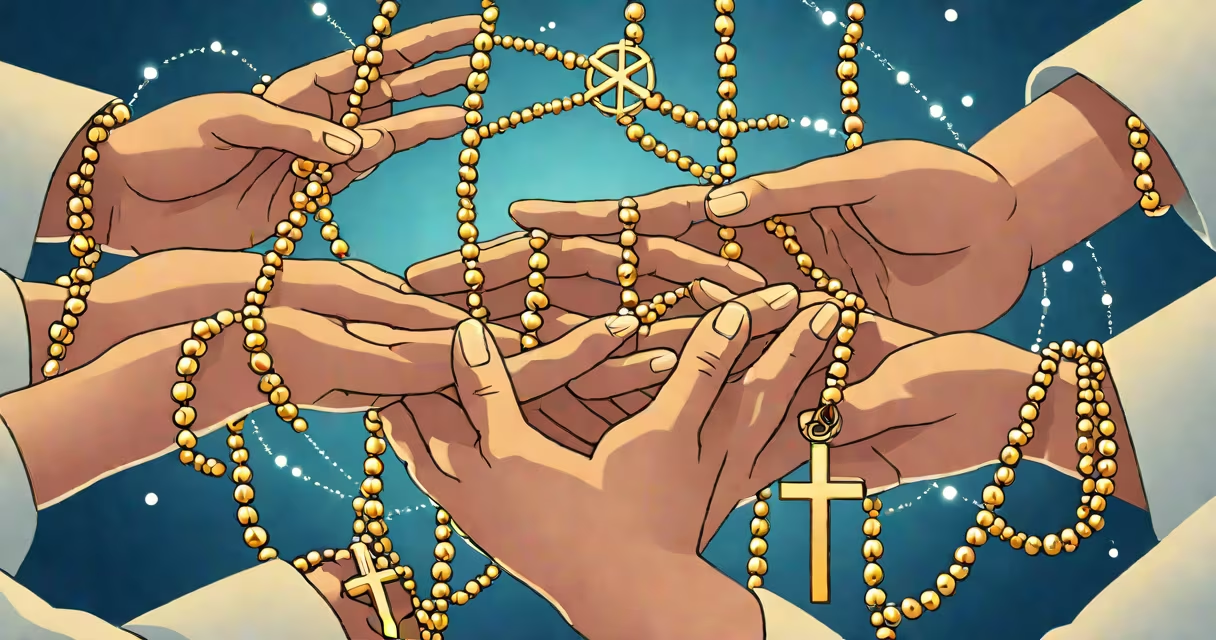
The glorious mysteries of the rosary meditations are a set of five Catholic prayers centered on Christ's resurrection, ascension, and glorification, intended to deepen spiritual reflection through meditation on His triumph over death and divine glory.
These meditations form part of the traditional four sets of mysteries in the rosary-joyful, sorrowful, glorious, and luminous-each assigned to specific days of the week. The glorious mysteries are prayed on Sundays and Fridays, aligning with the Church's liturgical calendar and the celebration of Easter. They follow a structured pattern: one mystery is reflected upon per decade of beads, with each mystery corresponding to a major event in Christ's post-resurrection life.
Each mystery includes a short narrative from Scripture, a reflective prayer, and a contemplative pause. The focus is not on memorizing facts but on internalizing the meaning of Christ's victory. For example, the resurrection of Jesus is not just a historical claim-it is a living reality that shapes Christian hope. This is why the Church encourages daily meditation on these events, especially during Eastertide and Lent.
Each decade of the rosary begins with the Our Father, followed by ten Hail Marys, and ends with the Glory Be. During the glorious mysteries, the faithful reflect on one of five key events: the Resurrection, the Ascension, the Descent of the Holy Spirit, the Assumption of Mary, and the Coronation of Mary as Queen of Heaven.
For the Resurrection mystery, the meditator focuses on Matthew 28:1-10, where Mary Magdalene and the other Mary find the tomb empty. The reflection centers on the emotional weight of that moment-the fear, disbelief, and overwhelming joy. The prayer invites the believer to ask, "Lord, where do I see You rising in my life?"
Unlike the joyful mysteries, which emphasize Christ's birth and childhood, or the sorrowful ones, which confront His suffering, the glorious mysteries show triumph. They are not about past events alone-they are invitations to participate in Christ's ongoing victory. The Church teaches that "the resurrection is the foundation of our faith" (Catechism of the Catholic Church, §631).
The five mysteries are grouped chronologically and spiritually, forming a progression from physical resurrection to eternal glory.
| Mystery | Scripture Reference | Key Theme |
|---|---|---|
| Resurrection of Jesus | Matthew 28:1-10 | Victory over death; new life |
| Ascension of Jesus | Acts 1:6-11 | Christ's return to heaven; divine authority |
| Descent of the Holy Spirit | Acts 2:1-4 | Pentecost; birth of the Church |
| Assumption of Mary | Revelation 12:1-2 (symbolic); Church teaching | Mary taken bodily into heaven |
| Coronation of Mary | Revelation 12:1-2; liturgical feast | Queen of Heaven; intercessor |
Each mystery is paired with a specific prayer intention. For the Ascension, the focus is on trusting God's plan even when He seems distant. For Pentecost, the call is to receive the Spirit and live boldly in service. These aren't abstract ideas-they're lived realities. A priest I once met in Rome told me he prays the glorious mysteries every Friday morning before Mass. "I don't just recite words," he said. "I feel the wind of the Spirit blowing through the church."
Many people assume the glorious mysteries are only about Mary's assumption and coronation. That's incorrect. While those are central, the core of the glorious mysteries lies in Christ's glorification. The Church emphasizes that Mary's role is secondary to Christ's triumph. As Pope Benedict XVI wrote in *Spe Salvi* (2007), "The resurrection is not a myth-it is the hinge of history."
Another misconception is that these meditations are passive. They are not. The faithful are asked to engage mentally and emotionally. The Catechism states that "prayer is not merely saying words-it is entering into communion with God" (§2709). Meditating on the Resurrection isn't about repeating "He is risen" like a mantra-it's about asking, "Where am I buried? Where is my hope rising?"
A less obvious point: the glorious mysteries were not always part of the rosary. The original rosary focused only on the joyful and sorrowful mysteries. The addition of the luminous and glorious mysteries came in the early 20th century. Pope John Paul II introduced the luminous mysteries in 2002, and the glorious ones were formally recognized in earlier liturgical traditions. The Church did not invent them-they were drawn from centuries of Marian devotion.
Consider a person praying the rosary on a Sunday morning. After the Our Father and the Hail Marys, they reach the first bead of the glorious mysteries. They say, "I believe in the resurrection of Jesus Christ..." and then pause. They visualize the stone rolled away, the angel's message, Mary Magdalene running to tell Peter. They reflect: "When was the last time I felt hope after despair?"
After the tenth Hail Mary, they say the Glory Be and move to the next mystery-the Ascension. They read Acts 1:9: "He was lifted up while they were looking on, and a cloud took Him out of their sight." They imagine the disciples standing on the Mount of Olives, eyes wide, hearts full of wonder. They pray: "Lord, help me trust Your plan even when I can't see You."
This process takes about 15 minutes. But the impact lasts longer. Research from the University of Notre Dame (2019) found that Catholics who pray the rosary regularly report higher levels of emotional resilience and spiritual clarity compared to non-praying peers. The study measured mood, stress, and sense of purpose over six months.
The glorious mysteries of the rosary meditations are not relics of the past. They are living prayers that invite believers into the heart of Christian hope-where death is conquered, heaven is open, and Mary reigns as queen beside her Son.