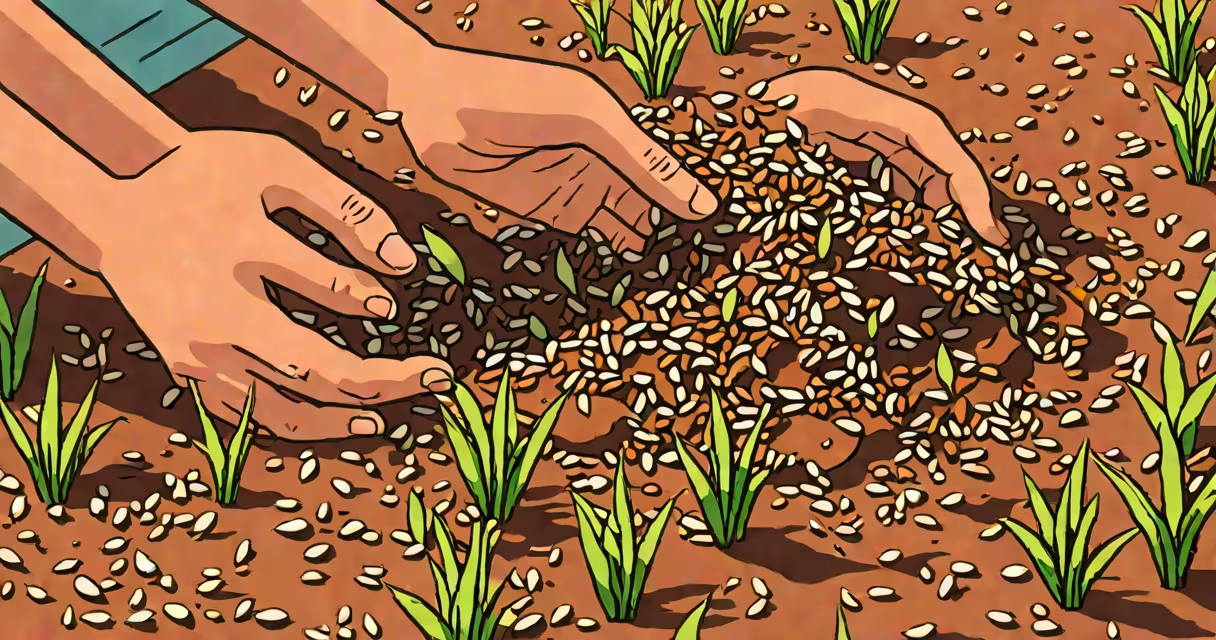
Ecclesiastes 11:1-6 is a passage from the Hebrew Bible's wisdom literature that combines agricultural metaphors with theological reflection, urging readers to act boldly while trusting God's unseen providence. It advises sowing seed in multiple fields, not waiting for perfect conditions, and acknowledging that outcomes remain beyond human control.
The passage appears in the book of Ecclesiastes, attributed to "the Teacher" (Qoheleth), who reflects on life's futility and the limits of human understanding. Yet within this structure of uncertainty, Ecclesiastes 11:1-6 offers a counterintuitive call: do not wait for ideal moments. Instead, cast your seed widely-even when skies are cloudy or storms loom-because you cannot predict where growth will take root.
Verse 1 begins: "Cast your bread upon the waters, for after many days you will find it." The image of casting bread on water echoes ancient Near Eastern practices of floating grain offerings or distributing food during times of scarcity. The metaphor implies generosity and trust in unseen returns. Verse 2 continues: "Give a portion to seven, or even to eight, for you do not know what disaster may come upon the land." This suggests spreading resources across multiple ventures, not concentrating risk in one place.
The logic of Ecclesiastes 11:1-6 operates through contrast: human effort versus divine oversight. The speaker acknowledges that people cannot control weather, harvest yields, or long-term outcomes. But they can choose to act anyway. The command to "cast" or "scatter" seed is active, not passive. It requires initiative in the face of uncertainty.
Verse 3 states: "If the clouds are full of rain, they pour rain upon the earth." This is not a promise of immediate reward-it's a statement of natural law. Rain falls regardless of whether someone is ready. Similarly, God's provision is not dependent on human timing. The farmer plants not because he knows the rain will come, but because planting is part of the cycle.
Verse 4 warns: "Whoever watches the wind will not plant; whoever looks at the clouds will not reap." This captures a central tension in human behavior: hesitation due to fear of failure or perfectionism. Waiting for perfect conditions prevents action. The passage calls this a trap. The wise person moves forward despite incomplete information.
The passage encourages diversified investment-not just in crops, but in relationships, projects, and opportunities. The instruction to give to "seven or eight" is not literal. It reflects the cultural idea of abundance and spread, similar to Proverbs 24:27 ("Prepare your work outside; get everything ready for your field before building your house").
| Action Type | Metaphor | Risk | Divine Oversight |
|---|---|---|---|
| Sowing seed | Planting efforts in uncertain environments | Loss due to drought, pests, or poor timing | God sees the hidden growth |
| Scattering bread | Generosity without immediate return | Wasted resources | Return comes unexpectedly |
| Watching the wind | Overthinking or delaying action | Missed opportunity | God governs wind and rain |
Modern applications include launching a business without guaranteed demand, investing in education without immediate payback, or mentoring others without visible results. The passage doesn't promise success-it promises integrity in the act itself.
Many interpret Ecclesiastes 11:1-6 as a call to "just go for it" without planning. That's incorrect. The passage assumes careful preparation. The farmer still plows, prepares soil, and selects seed. The instruction to "cast" does not negate diligence-it replaces paralysis with motion.
Another error is treating verse 6 as a formula: "If you sow, you'll reap." The original Hebrew uses conditional language tied to divine sovereignty. The verse says: "He who observes the wind will not sow, and he who watches the clouds will not reap." The outcome remains unknown. You don't control the harvest. You control your response.
A third misconception is applying the passage only to spiritual matters. While it appears in a religious text, its principles apply universally. A small business owner in Nairobi, a teacher in Chicago, or a nonprofit director in Manila can all benefit from the balance between action and surrender.
In 2018, a community garden project in Detroit faced funding cuts. Volunteers had planted 12 plots using donated seeds and compost. When a storm damaged half the beds, the team didn't abandon the rest. They replanted, shared tools, and reached out to local schools for student volunteers. After six months, three plots produced usable vegetables. One plot yielded enough to feed 15 families for a month. The project was not profitable-but it met its goal: nourishment and connection.
This mirrors Ecclesiastes 11:1-6. The team did not wait for perfect weather. They acted despite risk. Outcomes were mixed, but the effort mattered. As the text says, "You do not know what disaster may come," but you can still scatter your seed.
I once led a youth group that launched a literacy program in a rural village. We trained 12 students to tutor younger children. After three months, only four tutors remained. The rest dropped out due to family obligations or lack of motivation. We expected better results. But we kept going. A year later, those four became mentors themselves. Two now teach in nearby schools. The initial failure wasn't wasted-it was part of the process. The passage reminded me: you don't need to see the fruit to know the work is right.
Unlike prosperity theology, which equates faith with financial reward, Ecclesiastes 11:1-6 separates effort from result. The teacher says: "Do your work, but don't assume you'll see the harvest." This distinction is important. It protects against disappointment and burnout.
According to the King James Version, the passage reads: "Cast thy bread upon the waters: for thou shalt find it after many days." The verb "cast" implies release-not retention. You let go. The return is not yours to claim.
As scholar Robert Alter notes in *The Five Books of Moses* (2004), "The wisdom of Ecclesiastes lies in its refusal to offer false comfort. It does not promise that good deeds lead to good outcomes. It promises that good deeds are still right." This aligns with the passage's message: act, trust, and accept that results belong to God.
Compare Ecclesiastes 11:1-6 with Ecclesiastes 11:4, which warns against inaction driven by fear. The same chapter contains the famous line: "There is a time for everything, and a season for every activity under heaven" (Eccl 3:1). This reinforces the idea that timing is not ours to control-but decisions are.
Ecclesiastes 11:1-6 remains relevant because it confronts a universal human struggle: the urge to wait for certainty. The answer is not more data, but more courage. Plant your seed. Scatter your bread. Trust that the earth-and the One who governs it-will do the rest.