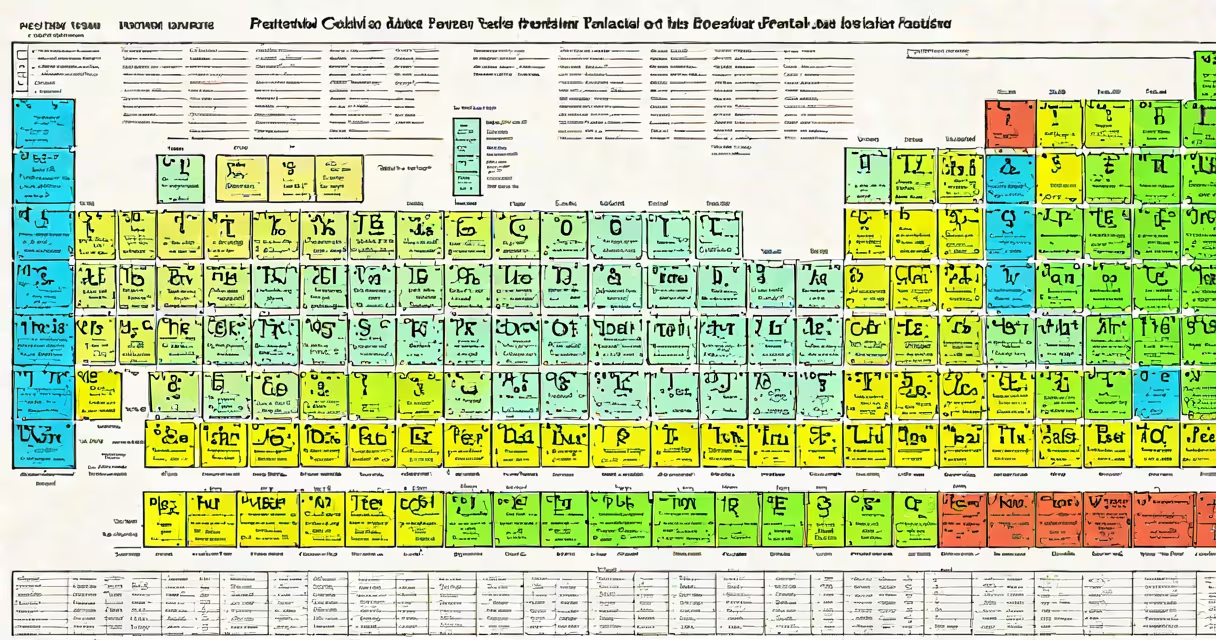
Each column of the periodic table is a group-elements with the same number of valence electrons and similar chemical behavior, organized vertically based on recurring patterns in atomic structure.
Elements in the same group share predictable traits: reactivity, ion formation tendencies, and bonding styles. For example, Group 1 (alkali metals) all form +1 ions and react violently with water. Group 17 (halogens) gain one electron to form -1 ions and exist as diatomic molecules. These similarities arise because group members have identical outer-shell electron counts.
The periodic table's layout reflects electron configuration. As atomic number increases, electrons fill shells and subshells in a repeating pattern. Elements in the same column have matching valence shell structures. Lithium (Li), sodium (Na), and potassium (K)-all in Group 1-have a single electron in their outermost s-orbital. This shared configuration drives their similar reactivity.
Modern periodic tables label groups using numbers 1 through 18. The older IUPAC system used Roman numerals and letters (e.g., IA, IIA, IIIA), but the current system avoids confusion between European and American notation. Group 1 is alkali metals, Group 2 alkaline earth metals, Group 17 halogens, and Group 18 noble gases.
Some groups have common names based on their chemistry. Group 1: alkali metals. Group 2: alkaline earth metals. Group 17: halogens. Group 18: noble gases. These names reflect trends-alkali metals are soft, reactive, and form basic oxides; noble gases are inert due to full valence shells.
Group 12 (zinc, cadmium, mercury) is often overlooked. Though they're transition metals by position, they lack typical transition metal behavior-no variable oxidation states or colored compounds. Their filled d-orbitals make them chemically stable and less reactive than neighboring elements.
Groups differ in physical and chemical behavior. The table below summarizes key group characteristics:
| Group # | Name | Valence Electrons | Reactivity Trend | Example Elements |
|---|---|---|---|---|
| 1 | Alkali metals | 1 | Increases down the group | Lithium, Sodium, Potassium |
| 2 | Alkaline earth metals | 2 | Increases down the group | Beryllium, Magnesium, Calcium |
| 17 | Halogens | 7 | Decreases down the group | Fluorine, Chlorine, Bromine |
| 18 | Noble gases | 8 (except He) | Very low reactivity | Neon, Argon, Krypton |
Reactivity trends follow electron distance from the nucleus. In Group 1, lithium reacts less vigorously than cesium because the outer electron is farther from the nucleus and easier to lose. In Group 17, fluorine is the most reactive halogen due to high electronegativity and small atomic size.
A non-obvious distinction: Group 13 includes boron (a metalloid) and aluminum (a metal), but the rest are metals. This shift in character within a group shows that periodic trends aren't always linear. Boron's brittleness and semiconducting behavior contrast sharply with aluminum's malleability and conductivity.
People often confuse groups with periods. A period is a horizontal row-elements with the same highest energy level. A group is a vertical column-elements with the same number of valence electrons. Confusing the two leads to errors in predicting reactivity or compound formation.
Another misconception: all elements in a group behave identically. While they share core traits, differences emerge down the group. Fluorine forms strong bonds with hydrogen (HF), but chlorine forms weaker HCl bonds. Bond strength decreases down Group 17 due to increasing atomic size and decreasing bond polarity.
Even the term "family" is misleading. While elements in a group are called a family, they don't interbreed or evolve. The name is purely metaphorical, reflecting shared ancestry in electron configuration, not biology.
Understanding each column of the periodic table is essential in materials science. For instance, Group 14 includes carbon (graphite, diamond), silicon (semiconductors), and tin (used in solder). Their differing properties stem from electron configuration and bonding modes-carbon forms covalent networks, silicon forms crystalline lattices, and tin exists in multiple allotropes.
In medicine, iodine (Group 17) is important for thyroid function. Its ability to form stable compounds with organic molecules makes it useful in radiographic imaging and antiseptics. Without knowing its group, clinicians wouldn't predict its reactivity or biological role.
I once designed a classroom model using colored beads to represent valence electrons. When students arranged elements by group, they saw how sodium (Group 1) donated one electron to chlorine (Group 17), forming NaCl. The visual confirmed that group identity predicts bonding behavior-and that each column of the periodic table is a blueprint for chemical interaction.
Each column of the periodic table is a group defined by shared valence electron count and recurring chemical behavior. This organization enables accurate prediction of element interactions, material design, and biological function. Recognizing this pattern is fundamental to chemistry.