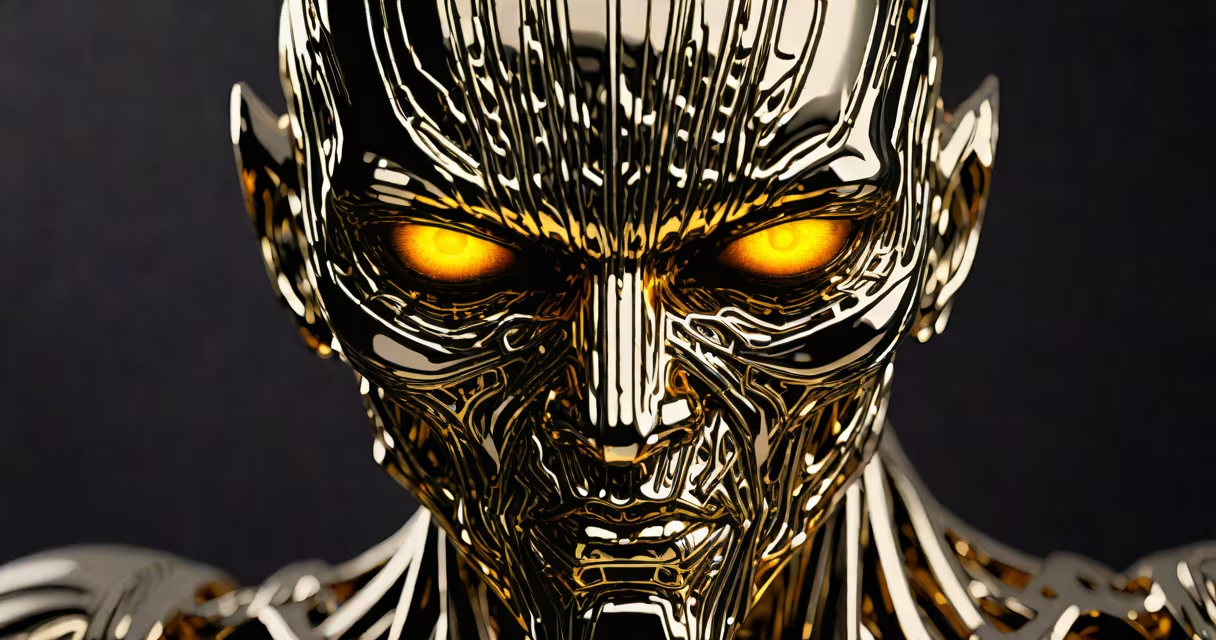
Carlos de Vil is a French-born contemporary artist whose work spans surreal sculpture, installation art, and conceptual design. He creates large-scale, often humanoid figures using industrial materials like steel, resin, and neon lighting, merging pop culture references with mythic symbolism. His pieces challenge viewers' perceptions of identity, form, and human presence.
De Vil's art operates at the intersection of fashion, mythology, and mechanical aesthetics. His sculptures frequently feature elongated limbs, oversized heads, and stylized facial features that evoke both futuristic androids and ancient deities. These forms are not meant to represent specific people but rather archetypes-figures caught between the organic and the artificial, the sacred and the consumerist.
He was born in 1983 in Lyon, France, and studied at the École Nationale Supérieure des Beaux-Arts in Paris. His early work focused on performance and wearable art, but he shifted toward permanent installations in the early 2010s. By 2016, his pieces began appearing in major galleries and public spaces across Europe and North America, including solo exhibitions at the Centre Pompidou in Paris and the Museum of Contemporary Art in Los Angeles.
De Vil constructs his sculptures using industrial fabrication techniques. He begins with 3D modeling software to design forms that distort human proportions-limbs stretch beyond anatomical limits, torsos twist into unnatural angles. Once finalized, the models are CNC-milled from foam blocks, then cast in fiberglass or resin. Metal frames are welded to support weight and structure, and surfaces are finished with high-gloss paint or polished steel.
Lighting plays a critical role. Neon tubing embedded within the figures pulses or glows in rhythmic patterns, mimicking breath or heartbeat. Some pieces include internal motors that slowly rotate limbs or open mouths. The effect is uncanny: the sculptures appear alive, yet their movements are mechanical, deliberate, and slightly off-kilter.
For example, his 2021 piece *L'Étrange*-a 3.2-meter-tall figure with a mirrored face and segmented arms-was installed in a Berlin courtyard. Viewers reported feeling watched even when unobserved. The sculpture's reflective surface distorted reflections, making it difficult to tell where the figure ended and the environment began. This blurring of boundaries is intentional: de Vil aims to disrupt the viewer's sense of spatial and bodily certainty.
De Vil's output falls into three primary categories: standalone sculptures, site-specific installations, and collaborative projects. Standalone works are typically displayed in galleries or private collections. Site-specific pieces are designed for a single location, adapting to architecture, light, and audience movement. Collaborations involve fashion houses, music artists, or tech companies.
| Type | Scale | Location Examples | Key Feature |
|---|---|---|---|
| Standalone Sculpture | 1.5-3.5 meters | Paris, New York, Tokyo | Self-contained, modular construction |
| Site-Specific Installation | Varies (up to 10 meters) | Berlin courtyard, Milan train station | Adapts to architecture and natural light |
| Collaborative Project | Variable | Coachella Festival, Balenciaga runway | Integrates fashion, music, or digital media |
His most recognized theme is the "post-human" figure-a being neither fully machine nor human, but something in between. This idea draws from French surrealist traditions, particularly the work of Jean Dubuffet and Salvador Dalí, but updates them with modern materials and digital-age anxiety. As noted in *Artforum* (2022), "de Vil's figures don't fear the future-they embody its dissonance."
Many assume Carlos de Vil is a fashion designer due to his frequent collaborations with luxury brands. While he has worked with Balenciaga and Givenchy on runway displays and store designs, his core practice remains visual art. He does not produce clothing or accessories for sale. His involvement with fashion is strictly curatorial and conceptual.
Another misconception is that his work is purely ironic or satirical. In reality, de Vil treats his subjects with solemnity. The exaggerated forms are not jokes-they are meditations on alienation, identity, and technological embodiment. His 2019 installation *Mon U De M*-a 2.8-meter-tall figure with a hollow chest housing a rotating mirror-was described by curator Sophie Béjean as "a ritual object for the anxious soul." The title, a play on French slang meaning "my soul," reflects the emotional weight behind the form.
A lesser-known fact: de Vil does not use live models or motion-capture data. All movement sequences are choreographed manually using stop-motion animation principles. He builds prototypes that move incrementally, then records the motion frame-by-frame. This method ensures precise control over timing and gesture, avoiding the uncanny valley effect common in AI-driven animations.
In 2022, I stood in front of *Mon U De M* during a preview at the Palais de Tokyo in Paris. The figure stood in a dim corridor, its mirrored chest reflecting the viewer's image back in fragmented pieces. When activated, the chest rotated slowly, breaking the reflection into disjointed fragments. After five minutes, the rotation stopped. The silence felt heavier than the sound had been.
This moment exemplifies de Vil's intent: to make the viewer feel both seen and unseen. The artwork doesn't ask for interpretation-it demands presence. It forces attention to the act of looking, and to the discomfort of being perceived.
His work has influenced a new generation of artists exploring artificial identity. In 2023, the Tate Modern included a de Vil piece in its "Digital Flesh" exhibition, alongside works by Refik Anadol and Heather Dewey-Hagborg. The inclusion signaled a shift in museum curation: institutions now treat digital-age identity as a valid subject for physical, sculptural expression.
Carlos de Vil's art resists easy categorization. He is not a sculptor in the classical sense, nor a digital artist. He occupies a space between disciplines-where materiality meets metaphor, and form becomes feeling. His work continues to evolve, with upcoming projects involving augmented reality overlays and kinetic soundscapes.
Understanding Carlos de Vil requires letting go of expectations about what art should look like. His figures are not representations of people-they are presences. They stand in rooms not to be admired, but to be acknowledged. To meet them is to confront a version of ourselves that is both familiar and strange.