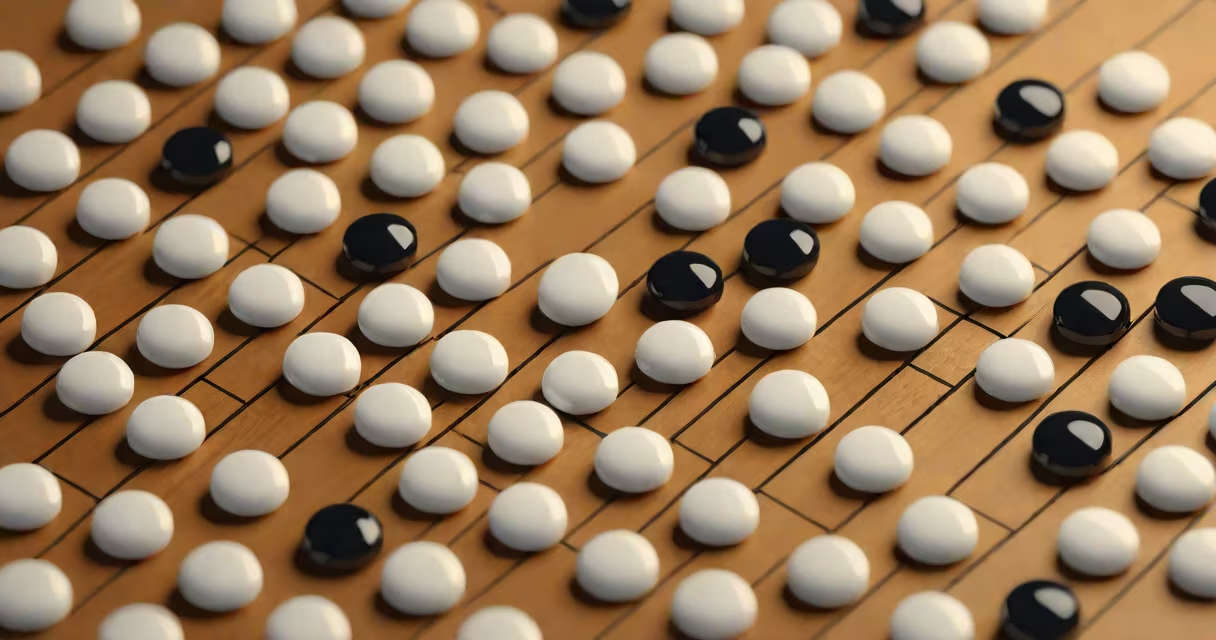
Alpha Go AI is a computer program developed by Google DeepMind that mastered the ancient board game Go by combining deep neural networks with reinforcement learning. It became the first AI to defeat a professional human player in Go under standard tournament conditions, marking a major milestone in artificial intelligence.
Go, played on a 19×19 grid, has more possible board positions than atoms in the observable universe-about 10^170. This complexity made Go a long-standing challenge for AI systems. Traditional algorithms used in chess engines failed because they couldn't evaluate positions effectively. Alpha Go solved this by learning patterns from millions of human games and then refining its strategy through self-play.
The system uses two key components: a policy network and a value network. The policy network predicts the next move based on the current board state, narrowing down the search space. The value network evaluates the likelihood of winning from a given position. These networks were trained using supervised learning on 30 million moves from human expert games, then fine-tuned via reinforcement learning through hundreds of thousands of self-play games.
Alpha Go's architecture combines deep convolutional neural networks with Monte Carlo tree search (MCTS). MCTS explores potential future board states by simulating random sequences of moves. Instead of brute-forcing every possibility-which is computationally impossible-Alpha Go uses the neural networks to prioritize high-probability moves.
During gameplay, the system runs thousands of simulations per second. Each simulation starts from the current board configuration and branches into plausible future positions. The neural networks assign probabilities to each move and estimate win chances. The algorithm selects the move with the highest expected outcome, balancing exploration and exploitation.
This hybrid design allows Alpha Go to handle both the strategic depth of Go and the computational limits of hardware. It doesn't rely solely on raw processing power-it learns to recognize patterns like "ladder" or "net" formations that humans associate with tactical advantage.
Google DeepMind released several versions of Alpha Go, each improving on the last. The progression reflects advances in training methodology and computational efficiency.
| Version | Release Year | Key Innovation | Notable Achievement |
|---|---|---|---|
| Alpha Go Zero | 2017 | Self-trained from scratch using only rules and self-play | Defeated Alpha Go Lee in 100-0 match; learned Go faster than human experts |
| Alpha Go Master | 2017 | Trained on human games and self-play, optimized for speed | Won 60 consecutive online games against top players worldwide |
| Alpha Go Lee | 2016 | Combined human game data with reinforcement learning | Defeated Ke Jie, world's top-ranked player, in a 3-game series |
Alpha Go Zero was particularly new. Unlike earlier versions, it didn't use any human game data. It began with only the rules of Go and improved by playing against itself. After just three days of training, it surpassed the performance of Alpha Go Lee. By day four, it had discovered novel strategies not seen in centuries of human play.
Alpha Go demonstrated that AI could achieve superhuman performance in domains requiring intuition, creativity, and long-term planning. Go was long considered a domain where human insight outperformed machines. But Alpha Go proved that deep learning models could internalize complex spatial reasoning and strategic foresight.
Its success influenced research in robotics, drug discovery, and climate modeling. For example, DeepMind applied similar techniques to predict protein folding in the AlphaFold project, which solved a 50-year-old problem in biology. The core idea-using neural networks to model complex systems and simulate outcomes-has become foundational in AI development.
A common misconception is that Alpha Go relied on massive computing resources to win. While it did run on specialized hardware (TPUs), the real breakthrough was in algorithmic design. Alpha Go didn't just calculate more moves-it learned to think like a master player. In one game against Lee Sedol, it played move 37-a move later called "the move that changed Go"-which surprised even top professionals.
People often confuse Alpha Go with general AI or chatbots. Alpha Go is narrow AI-it excels only at Go and related tasks. It cannot perform basic reasoning outside its domain. It doesn't understand language, emotions, or real-world physics. Its intelligence is confined to board configurations and game rules.
Another mistake is assuming Alpha Go's decisions are transparent. The neural networks make predictions based on weighted patterns, but the internal logic isn't interpretable. When Alpha Go chose move 37, no one could explain why-only that it led to a winning position. This opacity is a known limitation in deep learning systems.
Finally, some believe Alpha Go replaced human Go players. That's false. Players studied Alpha Go's games and incorporated new strategies into their own play. The AI didn't eliminate human expertise-it expanded it. Today, many top players train using Alpha Go's game database.
I watched the 2016 match between Alpha Go and Lee Sedol live in Seoul. When Alpha Go played move 78, a move that seemed illogical at first glance, the audience gasped. Lee Sedol paused for nearly ten minutes before resigning. Later, he said, "I felt like I was playing against a different kind of intelligence." That moment marked a turning point-not just in AI history, but in how we view machine cognition.
Alpha Go AI is a landmark achievement in artificial intelligence. It combined deep learning, reinforcement learning, and tree search to solve a problem long thought beyond machine reach. Its legacy lives on in fields ranging from healthcare to materials science. Understanding Alpha Go AI reveals how far AI has come-and how much further it can go. will i am ai continues to explore whether machines can truly think like humans.