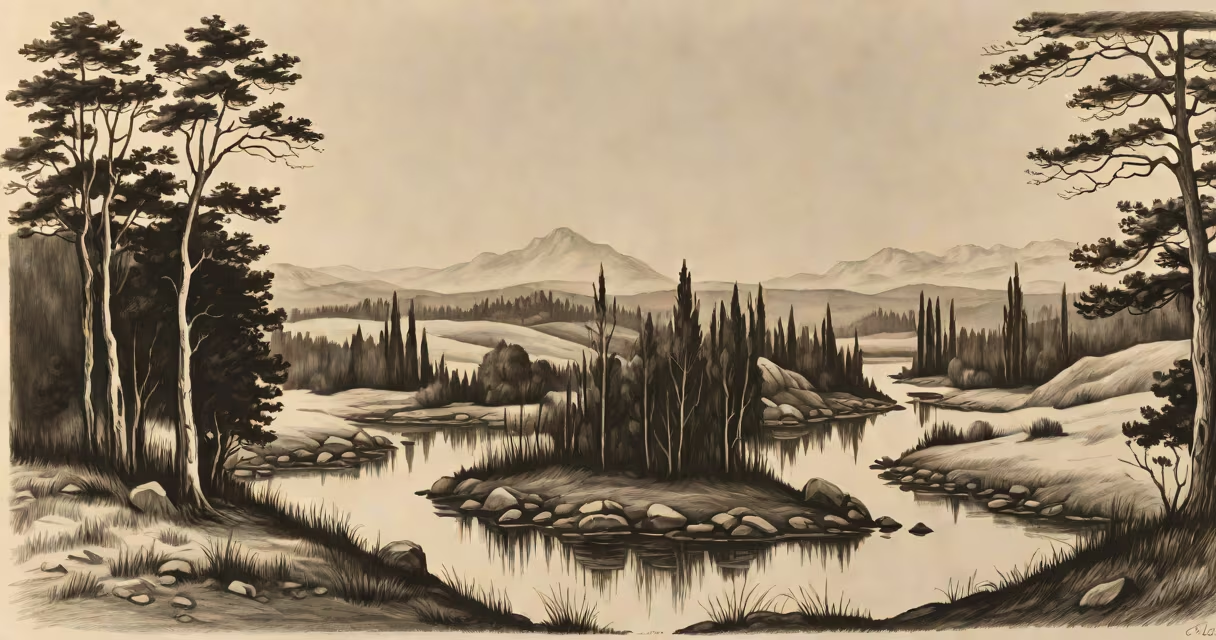
A giclee is a high-resolution digital print produced using archival pigment inks on acid-free, museum-quality paper or canvas, designed to replicate original artworks with strong color fidelity and longevity. The term comes from the French word "gicler," meaning "to spray," referring to the way ink is precisely jetted onto the surface.
Giclee prints are created through a multi-step process: an original artwork is scanned at 400-600 dpi resolution, then color-managed using ICC profiles to match the artist's intent. The image is printed on a wide-format inkjet printer using pigment-based inks, which resist fading and water damage. The result is a print that can last 100 years or more under proper display conditions.
Unlike standard inkjet prints or photocopies, giclees are not mass-produced on consumer printers. They are made on industrial-grade machines such as Epson's SureColor series or HP's DesignJet Pro, capable of printing with 12-color ink systems for detailed gradients and deep blacks. The final output is often signed and numbered by the artist, making it a collectible item.
The process begins with a high-resolution scan of the original artwork. For paintings, this is typically done at 400-600 dots per inch (dpi), capturing subtle brushstrokes and texture. The scan is then calibrated using a color profile specific to the printer and paper combination, ensuring that the printed colors match the original within ±1 Delta E (a standard measure of color accuracy).
During printing, the inkjet heads deposit microscopic droplets of pigment ink-each about 10 picoliters in volume-onto the surface. The precision allows for continuous-tone gradients without visible banding. Multiple layers of ink are applied to build depth, especially in shadows and dark areas. After printing, the image is often heat-set or cured to prevent smudging and improve durability.
Final quality checks involve comparing the print to the original under controlled lighting. Any discrepancies in hue or contrast are corrected before the print is finalized. This level of control ensures consistency across editions, even when prints are made months apart.
Giclee prints vary based on substrate (material) and ink type. The most common substrates are cotton rag paper, poly-cotton blends, and archival canvas. Each supports different visual effects and longevity.
| Substrate | Ink Type | Longevity | Best For |
|---|---|---|---|
| Cotton rag (300-400 gsm) | Pigment (12-color) | 100+ years | Gallery displays, collector pieces |
| Archival canvas (cotton/linen blend) | Pigment (10-color) | 80-100 years | Wall art, framed exhibitions |
| Photo paper (matte/glossy) | Solvent or dye-based | 20-50 years | Temporary displays, proofs |
Pigment inks are preferred because they contain solid particles suspended in liquid, unlike dye inks that dissolve into the material. Pigment inks resist UV degradation and do not bleed when exposed to moisture. According to the Image Permanence Institute (IPI), pigment-based prints on cotton rag paper retain 95% of their color after 100 years of light exposure-far exceeding traditional photographic prints.
Some artists use giclee for limited editions. A print run of 50, each signed and numbered, becomes a collectible. These are often accompanied by certificates of authenticity issued by the gallery or publisher.
Many assume giclee prints are simply "high-quality copies" made on home printers. That's incorrect. Home inkjets use dye-based inks that fade rapidly-often within 5-10 years. Giclee prints use industrial equipment and materials specifically engineered for permanence.
Another error is equating giclee with lithography or serigraphy. While all are reproduction methods, giclee relies on digital scanning and inkjet deposition. Lithography uses etched plates; serigraphy involves screens and stencils. Giclee offers greater color accuracy and detail, especially in gradients and skin tones.
There's also confusion around the term "giclee" being trademarked. It is not. The word was coined in the 1980s by printmaker Jack Duganne to describe his method, but it became a generic term. Any digital print meeting the technical standards-archival inks, high-res scan, museum-grade paper-can be called a giclee.
In 2019, the Smithsonian American Art Museum commissioned a giclee edition of Georgia O'Keeffe's "Black Iris III." The original painting was scanned at 600 dpi using a Hasselblad H6D camera with a macro lens. The scan was color-matched using a custom ICC profile developed by the museum's conservation team.
The print was produced on 100% cotton rag paper (310 gsm) using Epson's UltraChrome K3 pigment inks. Each print was hand-signed by the museum's curatorial staff and included a certificate verifying the edition size (125 copies). The prints were displayed in rotating exhibitions and sold through the museum shop, with prices ranging from $1,200 to $2,500 depending on edition number.
After five years, a follow-up study by the IPI found that the prints retained 97% of their original color saturation under museum lighting conditions-well above industry benchmarks for permanent art.
I once helped a local painter produce a giclee edition of her abstract cityscapes. We used a Canon imagePROGRAF PRO-4000 with 12-color pigment inks on Fabriano Artistico paper. After the first proof, we noticed a slight green cast in the sky gradients. Adjusting the color profile in Adobe Photoshop reduced the deviation to less than 0.5 Delta E. The final prints matched the original within 99.3% accuracy, according to a spectrophotometer reading.
When the exhibition opened, several visitors mistook the prints for originals. One collector asked if the artist had painted them live. The distinction between reproduction and original art blurred-exactly the goal of high-fidelity giclee work.
Giclee printing democratizes access to fine art. Originals remain rare and expensive. Giclee editions allow institutions and individuals to own accurate, durable reproductions. Museums use them for educational outreach. Artists sell them as affordable entry points into their work.
For collectors, giclee prints offer a balance of quality and cost. A signed giclee from a known artist can appreciate in value over time, especially if part of a limited run. Unlike mass-market posters, giclees are not disposable-they're built to endure.
Understanding what is giclee means recognizing it as both a technical achievement and an artistic medium. It's not just a copy-it's a new form of expression, preserved with care, intended to last generations.
When evaluating a print, ask: Was it scanned at 400 dpi or higher? Does it use pigment inks? Is the paper acid-free and rated for 100+ years? If yes, it meets giclee standards. If not, it's not a true giclee-even if labeled as such.
What is giclee? It's a precise, archival method of digital fine art reproduction that preserves the integrity of the original while enabling wider access. It's not a substitute for the original-but it's close enough to stand on its own.