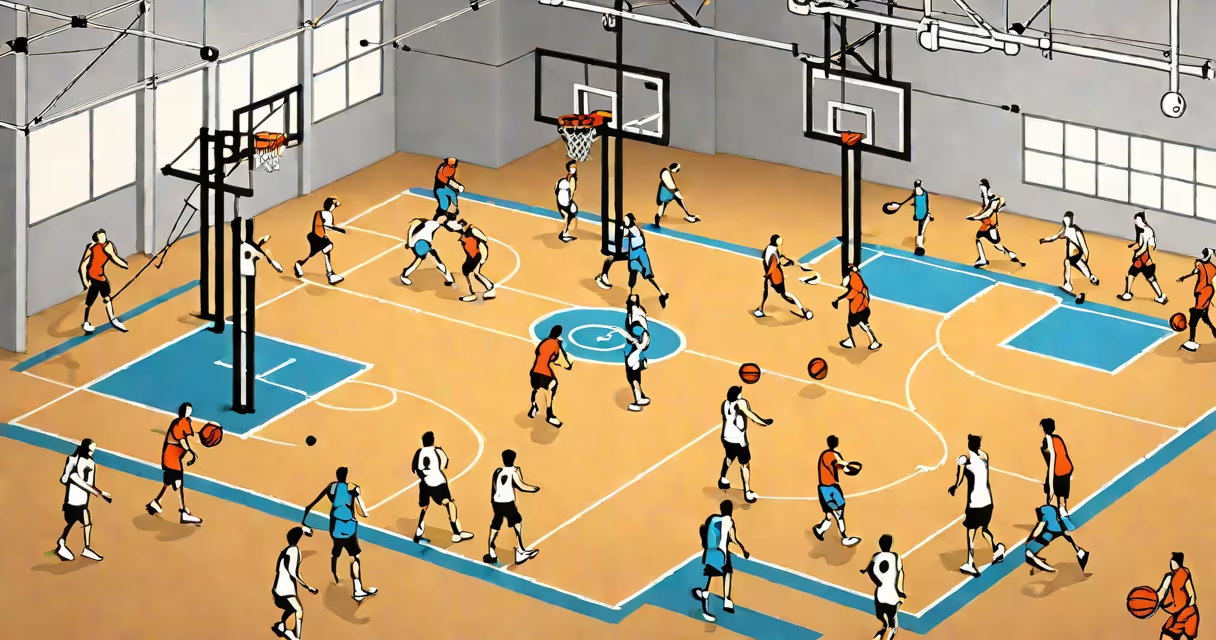
Open gym refers to unsupervised, drop-in sports sessions-most commonly basketball-where participants show up and play without formal teams, schedules, or coaching. These sessions are typically held in public gyms, recreation centers, or school facilities during designated hours.
Unlike league play or structured programs, open gym has no set roster, no referees, and no predetermined rules beyond basic safety and respect. Players arrive, join a game, and leave when they're done. The environment is informal, spontaneous, and accessible to anyone who wants to participate.
Open gym is common in urban areas and school districts. For example, many high schools in New York City offer open gym during evenings and weekends, allowing students and local residents to use the courts. According to the National Recreation and Park Association, over 60% of public recreation centers in the U.S. host at least one weekly open gym session.
Participants show up during posted hours, often with their own ball and shoes. There's no registration required. A few players usually form a pickup game on the court, and others join as space allows. Games may follow house rules-like no dunking, no contact, or a maximum of five players per side-but these aren't enforced uniformly.
Most open gyms operate on a first-come, first-served basis. If a court fills up, new arrivals wait until someone leaves. Some facilities limit sessions to two-hour blocks to manage usage. Courts are often monitored by staff or security, but no one enforces rules unless a conflict arises.
A key feature is the absence of formal structure. There are no team rosters, no coaches, no scorekeeping systems, and no penalties for violations. This makes open gym ideal for casual athletes looking to stay active without commitment.
While most open gym events center around basketball, variations exist across sports and settings:
| Type | Typical Location | Rules & Structure | Example |
|---|---|---|---|
| Basketball Open Gym | Public gyms, schools, recreation centers | Unregulated; player-led rules | NYC Parks Department's weekly open gym at Rucker Park |
| Adult Pick-Up Basketball | Community centers, YMCA branches | Often time-limited; no contact allowed | Seattle's West Seattle Community Center offers 7 PM-9 PM sessions |
| Youth Open Gym | Schools, youth centers | Supervised by staff; age restrictions apply | Chicago Public Schools host free after-school open gym for grades 6-12 |
| Open Gym with Coaches | Recreation centers with paid programming | Coaches may lead drills or organize games | Los Angeles Recreation Department offers "Coach-Led Open Gym" for $5/session |
Some open gyms are supervised. These differ from traditional open gym in that staff or trained volunteers monitor behavior and enforce basic conduct rules. Supervised sessions are common in youth programs and are designed to reduce injury risk and prevent disputes.
Open gym serves multiple purposes. It provides low-barrier access to physical activity, especially in neighborhoods with limited recreational infrastructure. For teens and young adults, it's a social outlet. For older adults, it's a way to maintain mobility and coordination.
According to the Centers for Disease Control and Prevention (CDC), regular participation in informal sports reduces the risk of heart disease and type 2 diabetes. Open gym contributes to this by encouraging consistent movement without requiring long-term commitments.
Many cities use open gym as a tool for community engagement. In Portland, Oregon, the city's recreation department runs "Basketball for All" nights at local parks, offering free equipment and volunteer referees. These events draw hundreds of attendees weekly, particularly during summer months.
Open gym is not the same as a recreational league. Leagues have fixed schedules, assigned teams, and officials. Open gym is fluid and unpredictable. You can't sign up weeks in advance or expect to play every week.
Another misconception is that open gym is always chaotic. While some sessions involve heated competition or verbal sparring, many are calm and inclusive. A 2022 study published in the Journal of Sport and Exercise Psychology found that 68% of participants in open gym reported feeling "welcome" and "relaxed," even in high-traffic environments.
Also, open gym doesn't require skill. You don't need to be good to play. Many sessions welcome beginners. At a session I attended at a Brooklyn community center, a 14-year-old boy with no prior experience joined a game and played for 45 minutes. He didn't score, but he stayed engaged and left smiling. That's the spirit of open gym.
Open gym is not a substitute for organized training. It lacks coaching, structured drills, and performance feedback. If you want to improve your jump shot or learn defensive positioning, open gym won't teach you those skills systematically.
It's also not a place for intense competition. While some players take it seriously, most sessions prioritize fun and accessibility over winning. Courts are often shared, and games end abruptly when someone leaves or a new group arrives.
Finally, open gym isn't always safe. Without supervision, incidents like collisions, property damage, or verbal altercations can occur. Facilities often post signs warning against alcohol, weapons, and aggressive behavior. Always check local guidelines before attending.
Open gym means casual, informal sports play open to anyone who shows up. It's not regulated, not scheduled, and not coached. It thrives on spontaneity and community. helping a kid learn to dribble, open gym offers a low-pressure way to stay active and connect with others.
If you're unsure about joining, start by visiting a session during off-peak hours. Bring your own gear, observe for a few minutes, and ask a participant if you can play. Most people welcome newcomers. You don't need to be skilled-just willing to show up.