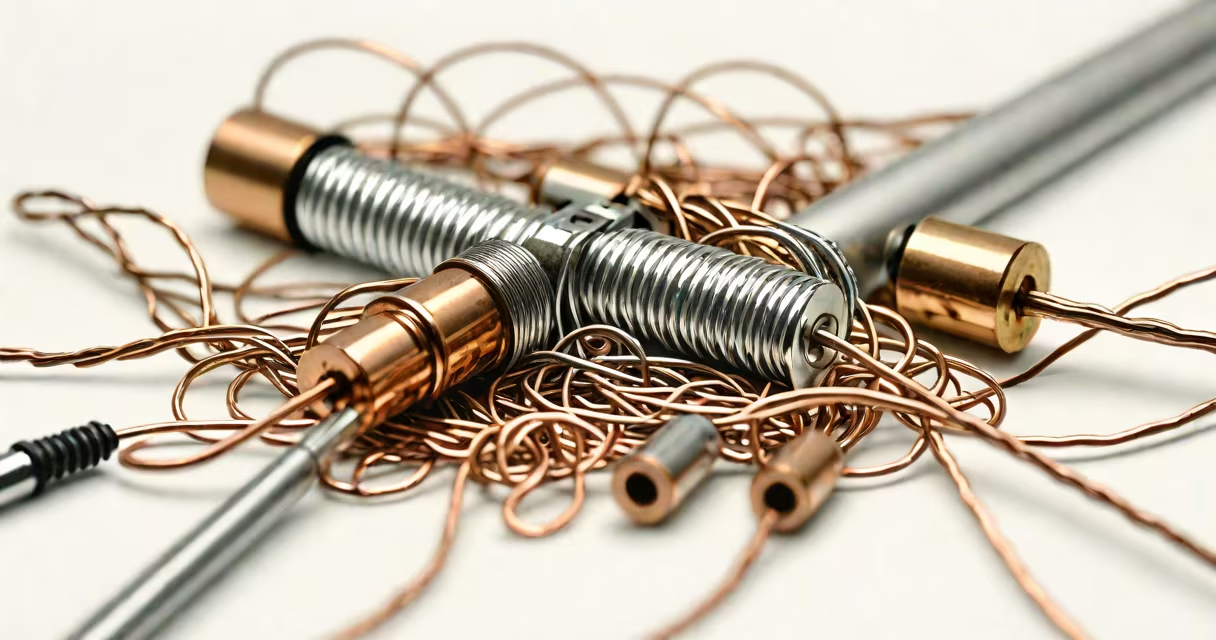
An electromagnet produces a magnetic field when an electric current passes through a coil of wire wrapped around a ferromagnetic core, such as iron. The strength and polarity of the field depend on the current's direction and magnitude. When the current stops, the magnetic field disappears. This controllable magnetism enables precise applications in industry, medicine, and everyday devices.
Electromagnets function through electromagnetic induction. When current flows through a wire, it creates a circular magnetic field around the conductor. Coiling the wire amplifies this effect. Wrapping the coil around a soft iron core concentrates and strengthens the field because iron aligns its internal magnetic domains with the applied field. The resulting magnet acts like a permanent magnet while powered but loses its magnetism instantly when power is cut.
The principle was demonstrated by Hans Christian Ørsted in 1820 when he observed that a compass needle deflected near a current-carrying wire. Michael Faraday later expanded on this, showing that changing magnetic fields induce electric currents-a foundation of modern electromagnetism. Today, this behavior underpins everything from generators to particle accelerators.
Current flowing through a wire generates a magnetic field perpendicular to the direction of electron flow. A single straight wire produces a weak, circular field. Coiling the wire into a helix-called a solenoid-creates a stronger, directional field along the coil's axis. The field lines converge inside the coil, forming a concentrated magnetic field similar to that of a bar magnet.
Adding a ferromagnetic core like iron increases the field strength by hundreds or thousands of times. Iron atoms have unpaired electrons whose spins align with the external field, reinforcing it. This alignment persists only while current flows. Once the current stops, thermal motion randomizes the atomic spins, and the material returns to a non-magnetic state.
A practical example: a 10-turn solenoid with 1 amp of current generates about 1.25 millitesla of magnetic flux density. Adding an iron core boosts this to over 1 tesla-strong enough to lift several kilograms of steel. This explains why industrial cranes use electromagnets to move scrap metal: they activate only when needed and release loads instantly by switching off power.
Electromagnets vary by design and purpose. Common types include solenoids, relay coils, and superconducting magnets. Solenoids convert electrical energy into linear mechanical motion and are used in valves, locks, and automotive starters. Relay coils control high-power circuits using low-voltage signals-common in home automation systems.
| Type | Structure | Typical Use | Field Strength |
|---|---|---|---|
| Solenoid | Coil around movable iron plunger | Door locks, fuel injectors | 0.1-1 Tesla |
| Relay Coil | Small wire winding on iron core | Circuit switching in appliances | 0.05-0.5 Tesla |
| Superconducting Magnet | Coils cooled to near absolute zero | MRI machines, particle accelerators | 1.5-20 Tesla |
Medical imaging relies heavily on electromagnets. MRI scanners use superconducting magnets to generate stable, high-intensity fields. These fields align hydrogen nuclei in the body. Radio waves then perturb them, and sensors detect the emitted signals to form detailed images. The 1.5 Tesla magnet in a standard MRI machine requires liquid helium cooling to maintain superconductivity-without it, resistance would cause overheating and failure.
Another non-obvious fact: electromagnets don't require continuous power to hold objects. Some designs use latching mechanisms. For example, industrial grippers use a pulse of current to set the magnetic field, then rely on residual magnetism to maintain grip. This saves energy and reduces heat buildup during long operations.
People often confuse electromagnets with permanent magnets. Permanent magnets, like neodymium or ferrite, retain their magnetic field without external power. Electromagnets only work when energized. A permanent magnet cannot be turned off; an electromagnet can be switched on and off instantly.
Another misconception is that all electromagnets are strong. In reality, small ones-like those in earbuds or phone vibration motors-produce weak fields. A typical headphone driver uses a 10 mm diameter coil with 100 turns and 10 mA of current. Its field strength is about 0.001 Tesla-too weak to affect nearby credit cards unless held extremely close.
Some assume electromagnets generate electricity. They don't. Instead, they consume electrical energy to produce magnetic force. However, moving a conductor through an electromagnet's field induces current-this is how generators work. The reverse process, converting motion into electricity, is electromagnetic induction, not electromagnetism itself.
I once built a simple electromagnet using 100 turns of insulated copper wire around a 10 cm iron nail. With a 9V battery, it lifted six small steel washers. When I disconnected the battery, the washers fell immediately. Reconnecting restored the pull. This confirmed the direct relationship between current flow and magnetic action.
During testing, I noticed that increasing the number of turns boosted lifting capacity. Doubling the turns from 100 to 200 nearly doubled the force, even with the same voltage. This shows that field strength scales with ampere-turns-the product of current and number of loops. A 1A current through 200 turns produces twice the magnetomotive force of 1A through 100 turns.
For reference, the National Institute of Standards and Technology (NIST) defines magnetic field strength in amperes per meter (A/m). The SI unit for flux density is tesla (T). One tesla equals one weber per square meter. These units allow engineers to calculate forces precisely using equations like F = BIL sinθ, where F is force, B is flux density, I is current, L is conductor length, and θ is angle between field and current.