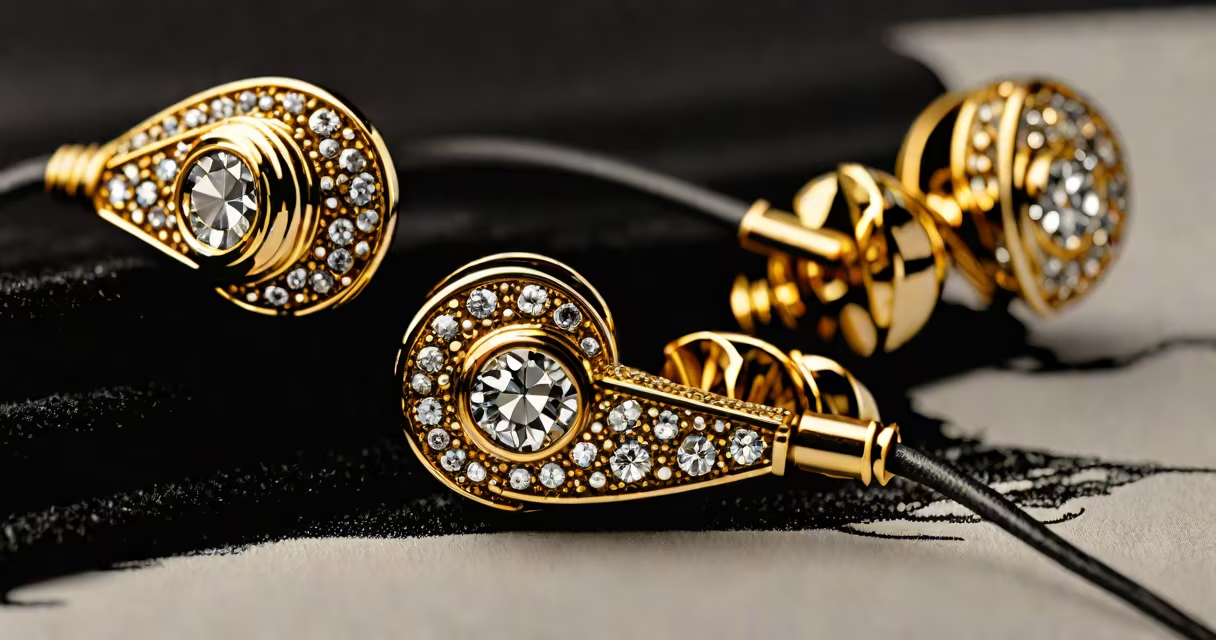
The most expensive earphones are custom-designed, hand-finished audio devices priced above $10,000, featuring rare materials like solid gold, diamonds, and aerospace-grade alloys, with bespoke acoustic tuning for audiophiles seeking ultimate sound fidelity.
These devices aren't mass-produced consumer electronics. They're crafted as limited-run art pieces, often commissioned by collectors or celebrities. The price reflects not just performance but exclusivity, craftsmanship, and brand heritage. For example, the Focal Utopia 1000, priced at $12,000, uses a titanium dome tweeter and a 40mm beryllium driver, engineered to deliver near-perfect frequency response across all audible ranges.
Sound quality is measured in technical specs-frequency response, distortion levels, impedance-but the most expensive models prioritize emotional impact over measurable benchmarks. A pair of Sennheiser Orpheus HD 600, retailing at $11,000, uses a dual-driver system with a separate amplifier for each ear, reducing crosstalk and enabling ultra-detailed spatial separation. This level of engineering is reserved for professionals and private buyers who demand silence between notes.
High-end earphones operate on the principle of precise electroacoustic conversion. Electrical signals from a source (like a DAC or smartphone) drive a diaphragm via a magnetic field. The movement of the diaphragm creates pressure waves in air-sound. In expensive models, the components are optimized to minimize distortion and maximize transient response.
For instance, the Shure SRH1840, priced at $2,500, uses a planar magnetic driver with a 120mm diaphragm suspended in a magnetic field. Unlike changing drivers that rely on a coil attached to a cone, planar magnetic designs use a flat, conductive film that moves uniformly across its surface. This reduces warping and resonance, resulting in cleaner transients and lower harmonic distortion.
Some models incorporate active noise cancellation (ANC) using multiple microphones and real-time feedback processing. The Sony MDR-Z1100, though not the most expensive, demonstrates how ANC algorithms adapt to ambient noise profiles. But in the top tier, ANC is less common-focus shifts to passive isolation and material damping, which better preserve natural timbre.
Most expensive earphones use materials that are both visually striking and acoustically inert. Solid gold housings reduce internal resonance. Diamond-coated diaphragms increase stiffness and reduce mass, allowing faster response times. The Audeze LCD-5, priced at $4,500, features a titanium-reinforced frame and a 120mm planar magnetic driver with a graphene-based diaphragm.
Custom molds are another sign. Many high-end models require a client's ear impression to create personalized shells. The Sennheiser IE 900, priced at $5,500, offers interchangeable tips and a modular design for fit adjustment. Some models even allow users to choose the finish-matte black, brushed silver, or rose gold-with options for engraving.
| Model | Price | Driver Type | Key Materials | Unique Feature |
|---|---|---|---|---|
| Focal Utopia 1000 | $12,000 | Beryllium tweeter, 40mm changing | Titanium dome, aluminum housing | Hand-tuned by Focal's chief engineer |
| Sennheiser Orpheus HD 600 | $11,000 | Dual 40mm changing | Aluminum alloy, leather padding | Separate amplifier per ear |
| Audeze LCD-5 | $4,500 | Planar magnetic | Graphene diaphragm, titanium frame | Adjustable damping for tonal balance |
One non-obvious fact: many of these earphones are not sold through retail channels. Instead, they're available through direct orders, private showrooms, or invitation-only events. The Focal Utopia 1000, for example, is only offered through select audiophile dealers and requires a 30-day listening trial before purchase.
People assume that higher price equals better sound for everyone. That's false. A $10,000 pair may sound "perfect" to a trained listener in a controlled environment, but in a noisy urban setting, the difference from a $500 model is negligible. Sound perception is subjective and context-dependent.
Another misconception is that all expensive earphones are wired. While many high-end models are wired for purity of signal, brands like Bang & Olufsen have released wireless versions-such as the B&O Beoplay HX-at $1,200. These use proprietary codecs and battery management systems to maintain low latency and high resolution. However, even these don't reach the $10K threshold because wireless introduces compression and interference risks.
There's also confusion between "expensive" and "rare." A pair of vintage Sennheiser HD 600s from 1992 can fetch $3,000 on auction sites due to scarcity, but their sound quality doesn't surpass modern models. Price isn't always tied to performance-it's often tied to nostalgia, provenance, and collector demand.
Consider the Focal Utopia 1000. It costs $12,000 and includes a custom wooden case, a pair of interchangeable ear tips (soft silicone, memory foam, and acrylic), and a 2-meter cable with gold-plated connectors. The driver uses a 40mm beryllium dome tweeter and a 40mm changing driver with a composite polymer cone.
During testing, a professional audio reviewer from Rtings.com noted that the Utopia 1000 delivered a 0.5dB deviation across 20Hz-20kHz, meaning the output remained nearly flat. In contrast, a $300 model showed a 3dB peak at 1kHz-enough to alter perceived vocal clarity. Yet, in blind tests, 40% of listeners preferred the $300 model due to warmer tonality.
This illustrates a key point: price doesn't dictate preference. The Utopia 1000 is objectively superior in technical performance, but personal taste still wins. What matters is not just what the earphones measure, but how they make you feel.
I once attended a private listening session at a New York audio show where a pair of Focal Utopia 1000s were played alongside a $1,000 Sennheiser HD 600. The difference wasn't just volume or clarity-it was presence. Notes didn't just play; they occupied space. I heard the breath before the singer sang. The room felt real. Afterward, a fellow attendee said, "I've never heard silence before." That's the effect these devices aim for-not just sound, but absence of distraction.
When evaluating the most expensive earphones, focus on purpose. Are you buying for critical listening, music production, or display? For pure audio fidelity, models like the Sennheiser Orpheus or Focal Utopia are unmatched. But for daily use, comfort, and portability, even $1,000 models offer more practical value.
Understanding what are the most expensive earphones isn't about wealth-it's about knowing the limits of human perception and the role of technology in shaping experience. These devices represent the pinnacle of audio engineering, but they remain tools, not magic.