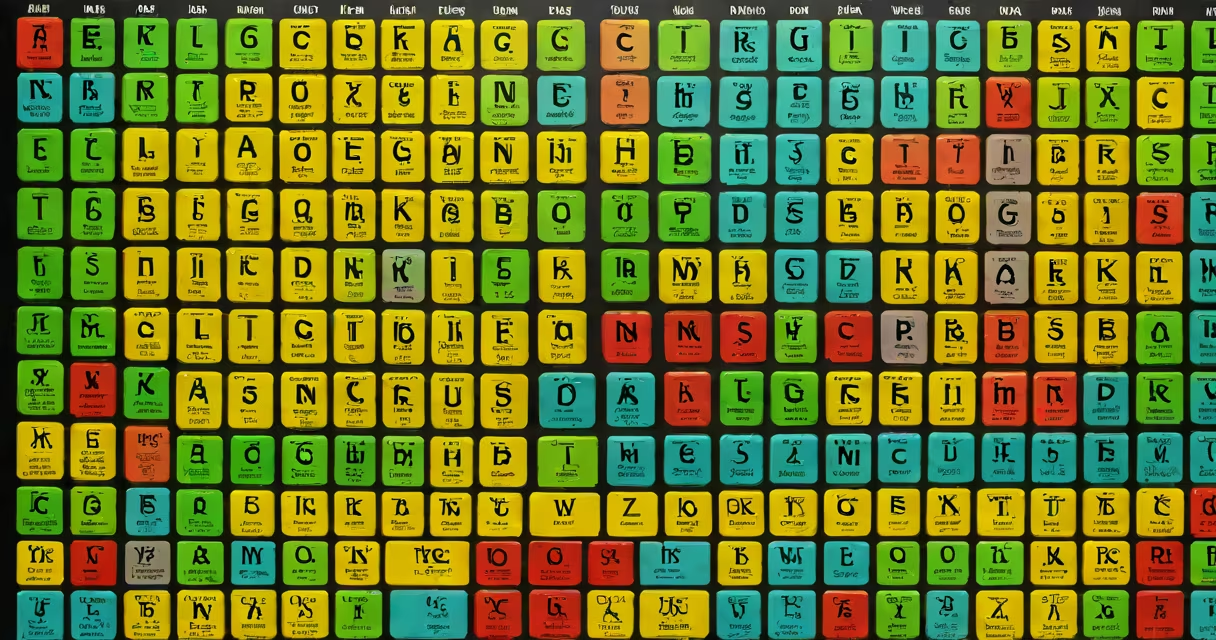
The periodic table with weights lists each chemical element alongside its standard atomic weight, a numerical value reflecting the average mass of atoms of that element based on natural isotopic abundance. This version extends the standard periodic table by including mass data essential for quantitative chemistry.
Atomic weight values are derived from measurements of isotopic composition across Earth's crust and atmosphere. For example, carbon's atomic weight is listed as 12.011 because it includes contributions from carbon-12 (98.9%) and carbon-13 (1.1%). These values are updated periodically by the International Union of Pure and Applied Chemistry (IUPAC).
Without atomic weights, calculations involving moles, molar mass, and reaction stoichiometry would lack precision. The periodic table with weights transforms abstract elements into measurable quantities used in labs, manufacturing, and academic research.
Each cell in the periodic table with weights contains the element's symbol, atomic number, and atomic weight. The atomic number (number of protons) defines the element. The atomic weight, shown below the symbol, reflects the weighted average of all naturally occurring isotopes.
For instance, chlorine has two stable isotopes: chlorine-35 (75.77% abundance) and chlorine-37 (24.23% abundance). Its atomic weight is calculated as:
(35 × 0.7577) + (37 × 0.2423) = 26.5195 + 8.9651 = 35.4846 ≈ 35.45This value appears on the periodic table with weights as 35.45, rounded to four significant figures.
These values are not constants. IUPAC revised chlorine's atomic weight in 2013 to a range (35.446-35.457) due to variations in isotopic ratios across different sources. This update reflects real-world differences in ocean water, minerals, and air samples.
There are several versions of the periodic table with weights, tailored for different uses:
| Type | Use Case | Weight Format | Source |
|---|---|---|---|
| Standard Reference | Classroom instruction, textbooks | Single value (e.g., 12.011) | IUPAC 2021 |
| Isotopic Range | Research, environmental science | Range (e.g., 35.446-35.457) | IUPAC 2013 |
| High-Precision | Laboratory analysis, materials science | Extended decimals (e.g., 12.0107) | NIST Atomic Weights Database |
Some tables display atomic weights in parentheses when they are uncertain or variable. For example, thorium's atomic weight is listed as [232.038] because it is based on a single isotope (thorium-232) and not a mix. The brackets indicate the value is not derived from natural abundance.
A common misconception is that atomic weight equals mass number. Mass number is the total protons plus neutrons in a specific isotope (e.g., carbon-12 has a mass number of 12). Atomic weight is an average across all isotopes and is usually not a whole number.
Chemistry students use the periodic table with weights to balance equations and calculate yields. A student preparing a 0.5 M solution of sodium chloride (NaCl) needs the atomic weights of Na (22.99) and Cl (35.45) to determine that the molar mass of NaCl is 58.44 g/mol.
In industry, manufacturers rely on atomic weights to scale production. For example, a pharmaceutical company synthesizing aspirin (C₉H₈O₄) uses atomic weights to ensure each batch contains exactly 180.16 grams per mole of compound. Errors in weight values lead to incorrect dosages and regulatory violations.
During my time working in a university lab, I once caught a discrepancy in a synthesis protocol. The recipe cited an atomic weight of 15.999 for oxygen, but a newer database listed 15.99903. The difference was small, but over 100 moles, it added up to nearly 1 kg of excess material. The error was traced to outdated reference sheets.
Many assume atomic weight is the same as atomic mass. Atomic mass refers to the mass of a single atom in unified atomic mass units (u). Atomic weight is the average across all naturally occurring isotopes. For example, the atomic mass of carbon-12 is exactly 12 u. The atomic weight of carbon is 12.011 u.
Another misunderstanding is that atomic weights are fixed. They are not. IUPAC updates them every few years based on new measurements. In 2021, the atomic weight of silicon was revised from 28.0855 to 28.0855(3), reflecting improved uncertainty estimates.
Some tables list "standard atomic weight" with a footnote indicating it applies only to terrestrial sources. This matters in astrophysics and space exploration. Martian rocks have different isotopic ratios than Earth rocks, so atomic weights differ slightly in extraterrestrial samples.
The periodic table with weights is not a static chart-it's a living reference shaped by ongoing measurement and revision. It enables accurate prediction in chemistry, from lab experiments to industrial processes. Always verify the date of the atomic weight values you're using, especially in research.