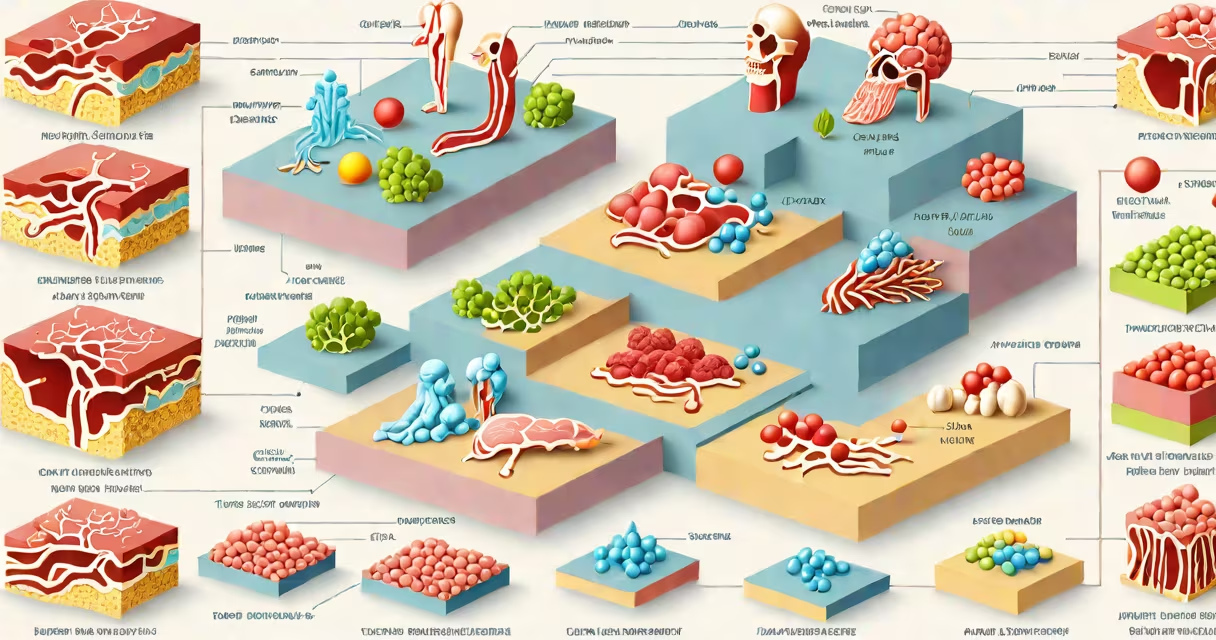
Levels of organization anatomy refer to the hierarchical arrangement of biological structures, starting from subatomic particles and progressing through molecules, cells, tissues, organs, organ systems, and the organism as a whole. This structure explains how complexity emerges step-by-step in living systems.
Each level integrates components from the previous one. For example, individual cells form tissues, tissues combine into organs, and organs work together in systems such as the circulatory or nervous system. This progression defines how structural and functional integration occurs in multicellular organisms like humans.
The concept is foundational in biology and medicine. It allows scientists and clinicians to analyze disease, understand development, and explain physiological processes. Without this structure, describing how a heart pumps blood or how nerves transmit signals would lack context.
At the most basic level, atoms bond to form molecules-such as DNA, proteins, and lipids-that carry out essential functions. These molecules assemble into organelles within cells, which are the fundamental units of life. A single human cell contains about 10 trillion atoms and thousands of distinct molecular complexes.
Cells then group into tissues based on shared structure and function. Epithelial tissue lines surfaces, connective tissue supports structures, muscle tissue enables movement, and nervous tissue transmits signals. Four primary tissue types exist in the human body, each with specialized roles.
Tissues combine to form organs. The heart, for instance, contains cardiac muscle tissue, connective tissue for structure, epithelial tissue lining chambers, and nervous tissue regulating rhythm. Organs perform specific tasks-like filtering blood in the kidneys or processing oxygen in the lungs.
Biological organization follows a consistent sequence. The table below outlines the six standard levels, with real-world examples from human anatomy.
| Level | Composition | Human Example |
|---|---|---|
| Molecule | Atoms bonded covalently | DNA double helix |
| Cellular | Organelles and cytoplasm | Neuron in the cerebral cortex |
| Tissue | Grouped similar cells | Skeletal muscle tissue |
| Organ | Two or more tissue types | Stomach (epithelial, muscular, connective) |
| Organ System | Multiple interacting organs | Circulatory system (heart, blood vessels, blood) |
| Organism | Entire living entity | A 70 kg adult human |
Each level adds functional complexity. A neuron can fire an electrical signal, but only when integrated into neural networks does it contribute to thought. Similarly, a single red blood cell transports oxygen, but only when part of the circulatory system does it sustain life.
Levels of organization anatomy are essential in medical education, clinical diagnosis, and research. When a physician examines a biopsy, they assess tissue structure to detect cancer. A pathologist looks at cellular abnormalities before diagnosing disease at the tissue level.
In neuroscience, researchers study brain function at multiple levels. Functional MRI scans show activity at the organ system level, while electrophysiology records signals at the cellular level. Combining both reveals how thoughts emerge from neural circuits.
Understanding this hierarchy prevents misdiagnosis. For example, a tumor may appear benign at the tissue level but aggressive at the cellular level. Missing this distinction leads to poor treatment outcomes.
Many assume that levels of organization apply only to animals. But plants, fungi, and even bacteria follow similar patterns. A fungal hypha consists of cells arranged into filaments, forming mycelium-a network akin to tissue. Bacterial colonies exhibit emergent behavior, though not true multicellularity.
Another misconception is that higher levels are always more complex. While true in structure, complexity doesn't imply superiority. A single-celled paramecium performs feeding, locomotion, and reproduction independently-functions that require coordination in multicellular organisms.
A key distinction often missed: levels are not rigid boundaries. Cells communicate via signaling molecules that affect tissue behavior. Hormones released by endocrine glands influence organ systems. These interactions blur the lines between levels, emphasizing integration rather than separation.
Consider a patient with chronic fatigue. Initial symptoms suggest a problem at the organism level-low energy, difficulty concentrating. Blood tests reveal low hemoglobin, indicating anemia. This points to a deficiency at the cellular level: red blood cells aren't carrying enough oxygen.
Further analysis shows iron-deficient erythrocytes. Iron is a molecule required for hemoglobin synthesis. The root cause lies in dietary intake or absorption issues-molecular and cellular deficiencies. Treatment involves supplements and dietary changes to restore iron levels.
This case illustrates how identifying dysfunction at one level informs intervention at another. Clinicians don't treat "fatigue" as a standalone issue-they trace it through the hierarchy until they find the source.
During a lab course, I observed students dissect a frog's heart. One group focused only on the organ's shape. Another analyzed the muscle fibers under a microscope and correlated them with the heart's pumping action. The latter group grasped how tissue structure enables organ function-exactly the insight levels of organization anatomy provide.
People often confuse levels of organization with biological systems. Organ systems-like the digestive or respiratory-are collections of organs working toward a goal. Levels of organization describe structural and functional integration across scales.
For example, the digestive system includes the mouth, esophagus, stomach, intestines, liver, and pancreas. Each organ operates at the organ level, but their combined function happens at the system level. The levels structure explains how these pieces fit together.
According to the National Institutes of Health (NIH), understanding hierarchical organization is critical for interpreting gene expression patterns across tissues. The Human Cell Atlas project maps molecular profiles across all cell types, linking them to tissue and organ functions.
The American Association for Anatomy reports that 92% of medical school curricula include formal instruction on levels of organization. This reflects its role in building conceptual coherence across disciplines-from biochemistry to clinical practice.
Levels of organization anatomy offer a precise way to describe biological complexity. From molecules to organisms, each level contributes to function and survival. Recognizing these layers improves diagnosis, research, and teaching.
When studying human physiology, always ask: at which level does this process occur? Is it cellular? Tissue-based? System-wide? This habit sharpens analytical thinking and prevents oversimplification.