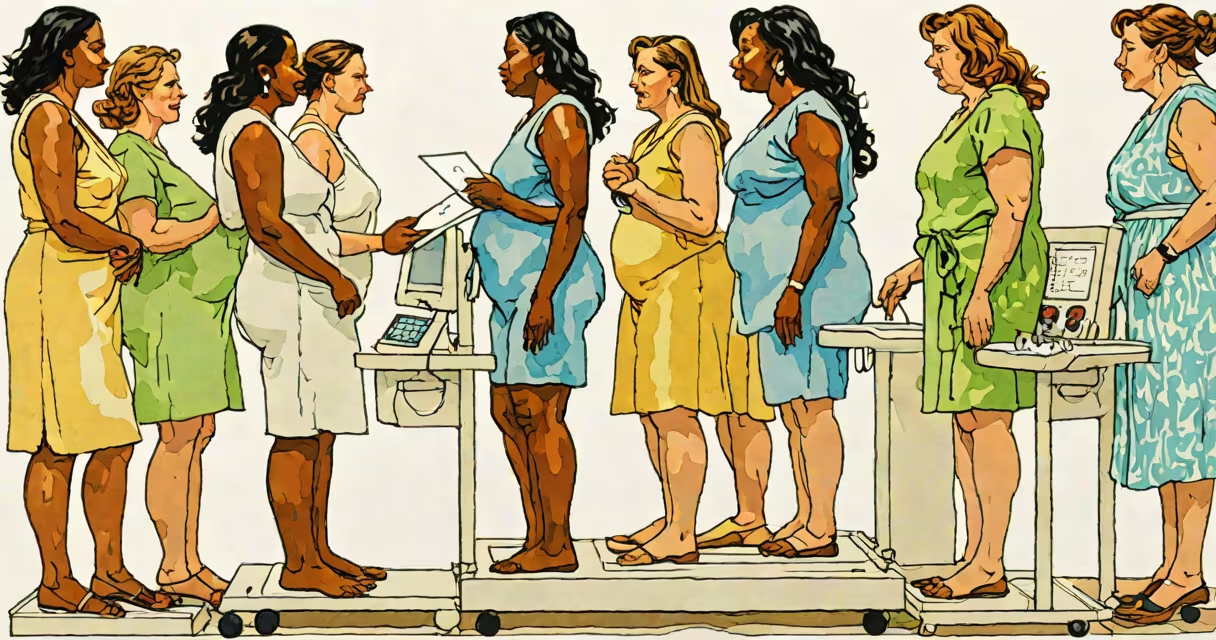
The average American woman weighs approximately 170.6 pounds, based on data from the Centers for Disease Control and Prevention's National Health and Nutrition Examination Survey (NHANES) collected between 2017 and 2020. This figure represents the weighted mean of measured body weights across a nationally representative sample of non-Hispanic White, Black, and Hispanic women aged 20 and older.
NHANES uses direct measurement in clinical settings rather than self-reporting, which reduces bias. The survey includes both height and weight data, allowing researchers to calculate body mass index (BMI) and assess obesity prevalence. Among women in this dataset, 42.4% were classified as obese (BMI ≥30), a rate that has increased steadily since the 1990s.
Weight varies by demographic subgroup. Non-Hispanic Black women had the highest average weight at 176.7 pounds, while non-Hispanic White women averaged 164.8 pounds. Hispanic women weighed 158.2 pounds on average. These differences reflect long-standing disparities in nutrition, healthcare access, and socioeconomic factors.
Data from NHANES are collected through mobile examination centers where trained technicians measure participants using calibrated scales and stadiometers. Participants remove shoes and heavy clothing. Weight is recorded in pounds and converted to kilograms for analysis. The final average is adjusted using statistical weights to represent the entire U.S. population.
For example, in the 2017-2020 cycle, 5,432 women aged 20+ were included in the sample. After applying population weights, the resulting estimate was 170.6 pounds. This method helps underrepresented groups-such as rural residents or those in low-income neighborhoods-are properly accounted for in national estimates.
Self-reported weight tends to be 5-10 pounds lower than measured weight. A 2019 study published in Obesity found that women who reported their weight accurately were less likely to have higher BMIs, suggesting social desirability bias affects reporting.
| Race/Ethnicity | Average Weight (lbs) | Mean BMI | Obesity Rate (%) |
|---|---|---|---|
| Non-Hispanic Black | 176.7 | 32.3 | 55.4 |
| Hispanic | 158.2 | 29.1 | 40.1 |
| Non-Hispanic White | 164.8 | 29.4 | 43.2 |
| Asian | 149.2 | 26.8 | 27.8 |
Age-related changes are notable. Women aged 20-39 average 157.6 pounds. By age 40-59, the average rises to 171.3 pounds. For women 60 and older, it increases to 174.6 pounds. This rise correlates with declining physical activity, hormonal shifts, and reduced muscle mass associated with aging.
One non-obvious factor: weight gain accelerates during menopause. A longitudinal study tracking 1,200 women over 10 years found that average weight gain between ages 45 and 55 was 12.3 pounds, with most fat accumulating around the abdomen-a known risk factor for cardiovascular disease.
Many assume the average American woman weighs 140-150 pounds, a figure often cited in media and fitness circles. That range reflects ideal or healthy weight targets, not actual population averages. The gap between perceived and measured weight highlights the influence of cultural ideals on public understanding.
Another misconception is that weight is uniform across regions. Data show regional variation: women in the South average 173.8 pounds, compared to 167.2 in the Northeast. This difference aligns with higher rates of obesity and lower access to fresh produce in certain states.
Some confuse "average" with "ideal." The CDC defines a healthy weight range based on BMI-not actual population weight. A woman who is 5'6" tall and weighs 170.6 pounds has a BMI of 29.4, which falls in the overweight category. This illustrates that being above average weight doesn't automatically indicate poor health, but it does increase risk for chronic conditions.
I once attended a wellness workshop where a speaker claimed the average American woman weighs 135 pounds. When I asked for the source, they cited a 2010 study that used self-reported data from a small, non-representative sample. The discrepancy underscores why relying on outdated or poorly sourced figures leads to misinformed conclusions.
Understanding actual population weight helps correct unrealistic expectations. It also informs public health policy. The CDC uses these numbers to allocate funding for nutrition programs, screen for metabolic disorders, and evaluate the impact of interventions like sugar taxes and school lunch reforms.
For comparison, a single U.S. penny weighs 2.5 grams. While unrelated to human weight, the contrast highlights how context matters: a penny's weight is precise and standardized, whereas human weight varies widely due to biology, behavior, and environment.
When evaluating personal health, focus on measurable indicators like waist circumference, blood pressure, and lab results-not just the number on the scale. The average American woman weighs 170.6 pounds, but individual health is better assessed through a combination of metrics and professional guidance.