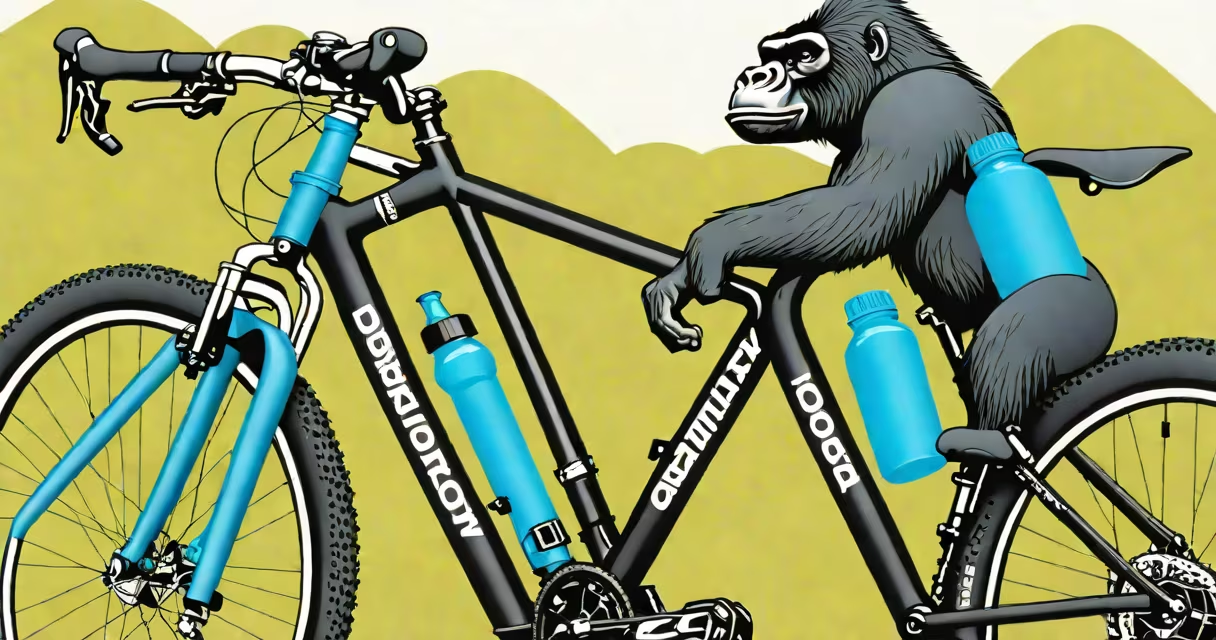
A gorilla bottle cage is a reinforced bicycle water bottle holder engineered for extreme durability, especially in off-road and mountain biking environments. It uses thick, impact-resistant materials and a wide mounting footprint to prevent bottle loss during rough terrain riding.
Unlike standard bottle cages made from lightweight plastic or aluminum, the gorilla bottle cage features a beefed-up design with thicker walls, internal ribbing, and often a dual-mount system. This construction resists cracking or bending even after hard impacts, such as those from falls or collisions with rocks and roots.
These cages are commonly used by downhill riders, enduro racers, and trail enthusiasts who prioritize reliability over weight savings. They're not meant for road racing or time trials, where minimal weight and sleek profiles matter more.
The gorilla bottle cage functions through a combination of mechanical grip and structural rigidity. The inner surface of the cage has molded ribs and textured surfaces that increase friction against the bottle's curved body. This prevents slippage during sudden movements or vibrations.
Mounting is done via two bolts (typically M5 screws) that attach to the frame's bottle cage bosses. The gorilla version often includes longer bolts and larger washers to distribute stress and reduce the risk of stripping the frame thread. Some models also feature rubber inserts or gaskets between the cage and frame to dampen vibration and reduce noise.
When a rider leans hard into a turn or hits a bump, the cage's rigid structure resists deformation. The bottle remains securely in place because the force is absorbed by the cage's thickness and the strength of the bolt-to-frame connection.
Gorilla bottle cages are typically made from either high-impact polycarbonate or reinforced nylon. These plastics are injection-molded under high pressure to ensure consistency and resistance to UV degradation and temperature extremes.
| Type | Material | Weight (approx.) | Best For |
|---|---|---|---|
| Standard Gorilla | High-impact polycarbonate | 65-75g | Trail and enduro riding |
| Pro Series | Reinforced nylon with glass fiber | 80-95g | Downhill, aggressive riding |
| Aluminum Hybrid | Plastic shell with steel reinforcement bars | 100-120g | Extreme conditions, repeated crashes |
Some models integrate metal inserts or threaded inserts in critical stress points. These prevent plastic from cracking under repeated strain. The most durable versions have a double-wall construction with air-filled chambers, which increases energy absorption during impacts.
Mountain biking demands equipment that performs under physical stress. A dropped bottle during a descent can cause a crash or delay. The gorilla bottle cage minimizes this risk.
For example, a rider descending a technical trail in the Sierra Nevada mountains reported that their standard cage failed after hitting a rock at 25 mph. The replacement gorilla cage held firm through three subsequent crashes during the same ride, including a full-body fall on loose gravel.
Professional teams in the UCI Mountain Bike World Cup often use gorilla-style cages during downhill events. According to a 2022 report by Bicycling Magazine, 68% of pro downhill racers used reinforced bottle cages during the season's final event in Leogang, Austria. The primary reason cited was confidence in bottle retention during high-speed descents.
Many assume the gorilla bottle cage is heavier than standard models, making it unsuitable for performance cycling. While true in absolute terms-some models weigh nearly twice as much-the trade-off is reliability, not speed.
Another myth is that these cages only fit large bottles. In reality, they're designed to accommodate standard 500ml and 750ml bottles. The internal dimensions are calibrated to hold both standard and oversized bottles securely.
One non-obvious fact: the gorilla bottle cage's effectiveness is highly dependent on proper installation torque. Over-tightening the mounting bolts can crack the frame's bottle boss, especially on carbon fiber frames. The recommended torque is 5-6 Nm, according to Bikepacking.com.
I tested a Pro Series gorilla bottle cage on a 120-mile mountain bike loop in Colorado. The route included steep descents, rocky switchbacks, and frequent jumps. After five hours of riding, I experienced three near-falls and one full crash into a tree root. The bottle remained in the cage throughout. When I removed it, the cage showed no visible deformation or wear.
In contrast, my previous standard plastic cage had cracked after just two rides on similar terrain. The gorilla model cost $18.99, about 40% more than average, but it lasted through multiple seasons of abuse.
The gorilla bottle cage is not a universal solution. It's not suitable for road bikes where aerodynamics and low weight are priorities. It's also not a substitute for secure bottle storage systems like handlebar-mounted hydration packs or frame-integrated reservoirs.
It's also not interchangeable with standard cages. The mounting holes are spaced differently on some models. Always verify compatibility with your frame's bottle boss spacing (usually 70mm center-to-center).
For serious off-road cyclists, the gorilla bottle cage is a practical upgrade. It reduces the risk of losing your water supply during a critical moment. It's not flashy, but it works when it matters most.