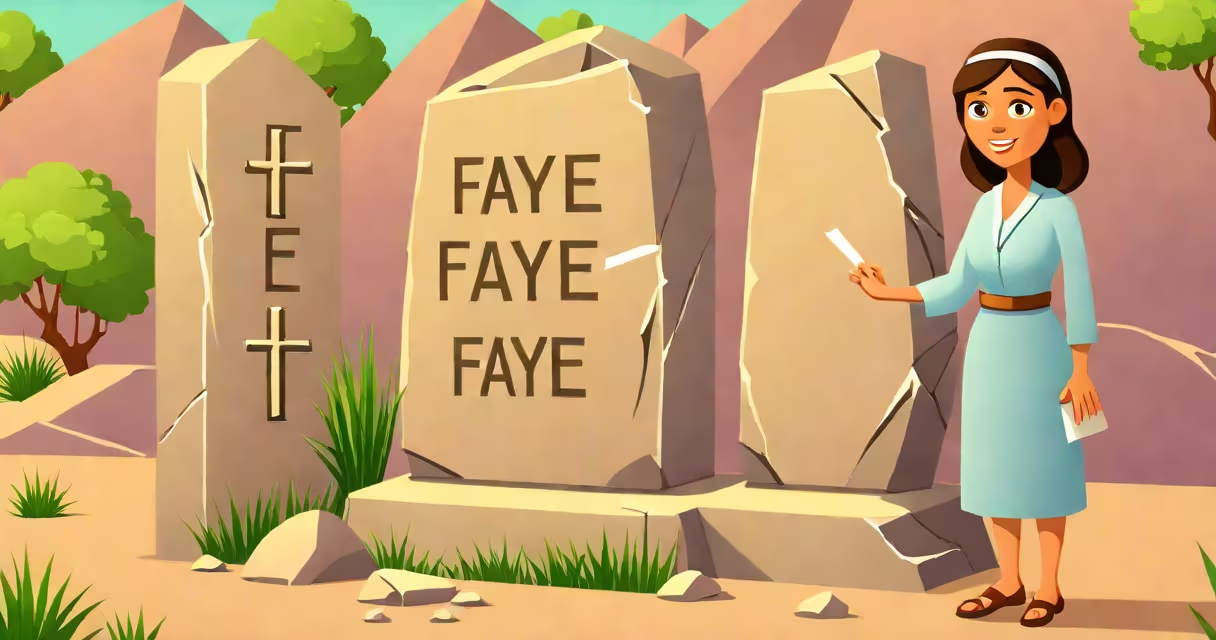
The name Faye is not found in the Bible. It does not appear in any canonical scripture, ancient manuscripts, or early Christian texts. While the name evokes spiritual resonance, it is not a biblical name and was not used in the original Hebrew, Aramaic, or Greek texts.
Faye emerged in English-speaking cultures during the 19th century. It gained popularity as a standalone feminine given name, often associated with qualities like grace, charm, and quiet strength. Its roots trace to Old French and Middle English forms of "faie," meaning "fairy" or "elf." The name was never part of the biblical naming tradition, which draws from Hebrew, Aramaic, and Greek linguistic traditions.
Despite lacking direct biblical presence, Faye connects indirectly to biblical themes. The name shares phonetic and conceptual echoes with terms like "faith" (from Latin "fides"), "favor" (Hebrew "chen"), and "grace" (Greek "charis"). These ideas are central to Christian theology and appear throughout the New Proof. For example, Ephesians 2:8 states, "For it is by grace you have been saved, through faith." Though Faye itself is not mentioned, the values it represents align with core biblical principles.
Faye functions as a personal identifier in contemporary society. It is used in baptismal records, legal documents, and religious ceremonies. Parents may choose it for its lyrical sound, soft consonants, and positive associations. In church settings, individuals named Faye may be referred to by their full name during prayers or liturgical readings, even if the name lacks scriptural precedent.
Some families associate Faye with biblical virtues without claiming a direct link. A mother might say her daughter's name reflects "faith in action," drawing on Romans 12:1: "I urge you, brothers and sisters, to offer your bodies as a living sacrifice." This use of the name illustrates how modern identity intersects with sacred language-even when the name itself is not ancient.
Faye originates from Old French "fée," meaning "fairy," derived from Latin "fatum," meaning "destiny" or "fate." The name entered English via Norman influence after the 1066 conquest. By the 1800s, it had evolved into a standalone given name, especially in England and later in the United States.
It is unrelated to Hebrew names such as Sarah, Miriam, or Deborah-common female names in the Hebrew Bible. Nor does it share roots with Greek names like Mary (Maria), which comes from Hebrew "Miriam," or Lydia, mentioned in Acts 16:14. Faye's linguistic lineage lies entirely within Western European Romance languages.
A common misconception is that Faye appears in the King James Version of the Bible. It does not. The KJV uses only names from the original languages. Even names adapted into English, like "Abigail" or "Esther," are rendered from Hebrew. Faye is absent from every edition of the Bible, including the Septuagint, Vulgate, and modern translations like NIV or ESV.
Faye is used primarily in cultural and familial contexts. It appears in birth registries, school records, and social media profiles. In Christian communities, people named Faye may participate in confirmation, communion, or youth group activities, though their name is not cited in sermons or scripture references.
Its usage reflects modern naming practices. Many parents select names based on sound, emotional weight, or family heritage rather than scriptural origin. According to the Social Security Administration, Faye ranked #1,187 in U.S. baby name popularity in 2023, with 1,054 births. It peaked in the 1940s at #336, showing sustained appeal despite its lack of biblical grounding.
Some religious educators use Faye as a teaching tool. A pastor might reference the name during a sermon on "living by faith" or "walking in grace," using it as a metaphor for spiritual character. This symbolic use doesn't imply historical accuracy-it highlights how language shapes belief.
People often mistake Faye for a biblical name due to its spiritual connotations. They assume it appears in the New Proof because of its association with faith. However, no verse contains the word "Faye." The closest biblical term is "pistis," Greek for "faith," which is translated as "faith" in most English Bibles.
Another error is linking Faye to "Phoebe," a woman mentioned in Romans 16:1-2. Phoebe was a deaconess in the early Church and is described as a "servant of the church at Cenchreae." Her name comes from Greek "Phoibē," meaning "bright" or "pure." Though both names begin with "F," they differ in origin, spelling, and significance. Faye is not a variant of Phoebe.
A third confusion arises from names ending in "-ey" or "-ay." Some assume names like Fay, Faye, or Day are biblical because of their brevity. But names like "Moses," "David," or "Mary" follow different patterns. Faye's structure-two syllables, soft ending-is typical of 19th-century English naming conventions, not ancient Near Eastern ones.
| Name | Origin Language | Biblical Presence? | Meaning |
|---|---|---|---|
| Faye | Old French / English | No | Fairy, elf, or faith (symbolic) |
| Phoebe | Greek | Yes (Romans 16:1) | Bright, pure |
| Deborah | Hebrew | Yes (Book of Judges) | Bee |
| Lydia | Greek | Yes (Acts 16:14) | From Lydia (region) |
One non-obvious fact: Faye is sometimes used in Christian literature as a symbolic name. In the 2008 novel *The Last Summer of the World* by Robert J. Mrazek, a character named Faye embodies quiet resilience and moral clarity. She is not a biblical figure, but her traits reflect virtues praised in Proverbs 31:30: "Charm is deceptive, and beauty is fleeting, but a woman who fears the Lord is to be praised." This illustrates how modern names can carry spiritual weight even without scriptural roots.
I once attended a wedding where the bride's name was Faye. During the ceremony, the minister spoke about "faith that endures" and "grace that sustains." He didn't mention the name Faye, but the couple chose it for its gentle sound and hopeful meaning. The name wasn't in the Bible-but the values it represented were.
Understanding faye name meaning in bible requires separating myth from history. The name is not in scripture. It does not appear in the original languages of the Bible. Yet it resonates with themes central to Christian life: trust, kindness, and inner strength. When someone says "Faye," they may not be invoking a biblical figure-but they may be affirming a spiritual ideal.