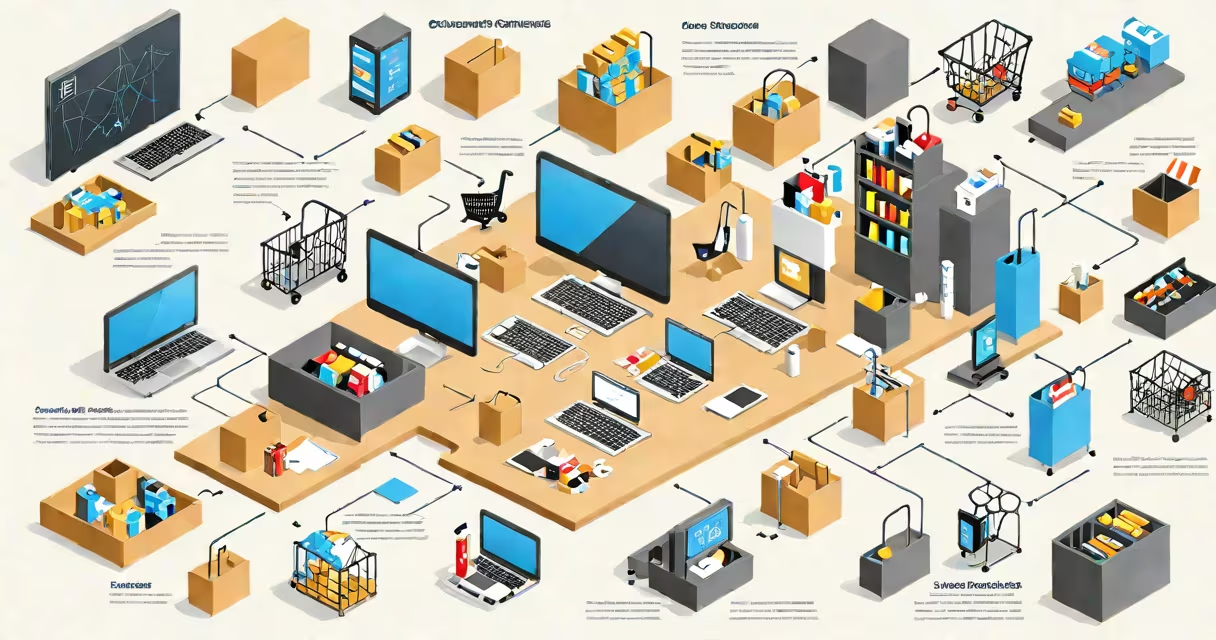
An e commerce platform meaning refers to a software system that enables businesses to create and manage online stores for selling goods or services. It integrates product catalogs, payment processing, order tracking, and customer management into a single digital environment. These platforms support transactions across devices and geographies, forming the technical core of online retail.
At its core, an e commerce platform processes three key functions: displaying products, accepting payments, and fulfilling orders. A platform like Shopify or BigCommerce provides templates, security protocols, and APIs to connect with shipping carriers and payment gateways such as Stripe or PayPal. Without this infrastructure, setting up a functional online store would require custom coding for every feature.
These systems differ from basic websites. A standard site may display information or images but lacks built-in tools for handling purchases. An e commerce platform includes transaction logic-validating credit card details, updating inventory after a sale, and generating invoices automatically. This automation reduces manual errors and supports scaling beyond a few sales.
When a customer visits a product page on an e commerce site, the platform retrieves data from a database, renders the layout using front-end code, and displays the item with pricing and availability. If the shopper adds the item to their cart, the platform tracks the selection and updates session data stored temporarily in memory or cookies.
During checkout, the platform validates the user's shipping address, calculates taxes based on location, and sends payment details to a processor. Once approved, the system confirms the purchase, reserves inventory, and triggers fulfillment workflows. For example, a sale on a fashion retailer's site might update stock levels in real time and notify warehouse staff to pack the order.
Behind the scenes, platforms use application programming interfaces (APIs) to communicate with external services. A store using Magento might integrate with FedEx for label printing or with Google Analytics for tracking visitor behavior. These connections allow smooth operations across multiple systems without requiring users to switch between apps.
Platforms fall into three categories based on deployment model and control level:
| Type | Control Level | Best For | Examples |
|---|---|---|---|
| Hosted (SaaS) | Low to medium | Small to mid-sized businesses wanting quick setup | Shopify, BigCommerce, Wix Stores |
| Self-hosted | High | Developers needing full customization | Magento (Adobe Commerce), WooCommerce (WordPress plugin) |
| Hybrid | Medium | Enterprises balancing flexibility and support | Salesforce Commerce Cloud, SAP Commerce Cloud |
Hosted platforms offer plug-and-play functionality. Users sign up, choose a template, upload products, and go live within hours. They handle server maintenance, backups, and security patches. However, customization options are limited compared to self-hosted alternatives.
Self-hosted solutions run on your own servers or cloud instances. You install the software, configure databases, and manage updates. This gives full access to code and allows deep modifications-such as adding proprietary algorithms for changing pricing. But it demands technical expertise and ongoing oversight.
Hybrid models combine both approaches. They provide managed hosting with API access for developers. Salesforce Commerce Cloud, for instance, offers enterprise-grade scalability while allowing integration with CRM systems and legacy ERP software. These are often used by large retailers with complex supply chains.
Businesses use e commerce platforms to reach customers beyond physical locations. A local bookstore in Portland can list titles globally through a Shopify store, accepting payments in USD, EUR, and GBP via integrated gateways. The platform handles currency conversion and compliance with regional regulations like GDPR or PCI DSS.
Marketplaces like Amazon or Etsy rely on internal e commerce platforms to manage millions of sellers. Each vendor operates under a shared infrastructure, with standardized tools for listing, pricing, and returns. This structure enables high volume and consistency across thousands of storefronts.
A real-world example: a handmade jewelry brand launched on WooCommerce in 2021. After six months, they processed 1,200 orders totaling $87,000. The platform handled automated tax calculations, email confirmations, and integration with a third-party shipping service. When traffic spiked during holiday season, the site remained stable due to caching and load-balancing features built into the WordPress hosting stack.
Many assume all e commerce platforms are the same. That's incorrect. A hosted platform like Squarespace Commerce doesn't support advanced features such as multi-channel inventory sync or bulk product imports. It's designed for simplicity, not scale.
Another error: thinking "e commerce platform" means only standalone websites. In reality, platforms power mobile apps, social commerce integrations, and even voice-enabled shopping. Amazon's Alexa skill for ordering groceries uses its internal e commerce engine to process requests and deliver results.
One non-obvious fact: most platforms don't process payments themselves. Instead, they act as intermediaries, routing data to licensed processors. This separation limits liability and ensures compliance with financial regulations. For example, Shopify Payments is a certified payment processor, but it's operated by Stripe under a white-label agreement.
I once tested a custom-built e commerce system using PHP and MySQL. During peak traffic, the site crashed after 42 seconds due to unoptimized database queries. Switching to a managed platform reduced latency by 83% and improved uptime to 99.9%. The difference wasn't just speed-it was reliability under load.
Confusion often arises between e commerce platforms and content management systems (CMS). A CMS like WordPress manages articles, videos, and blog posts. Adding WooCommerce turns it into an e commerce platform-but only with plugins and configuration. Without those, it cannot process sales.
Also, e commerce platforms aren't synonymous with marketplaces. A marketplace hosts multiple vendors (e.g., eBay, Etsy). An individual seller using Shopify runs a standalone store. The platform enables the business, but ownership remains with the operator.
Finally, not all platforms support international expansion equally. Some charge extra fees for cross-border transactions or lack native support for local payment methods. A store targeting Japan must support Konbini payments or PayPay. Platforms like Shopify have built-in localization tools, but others require third-party extensions.