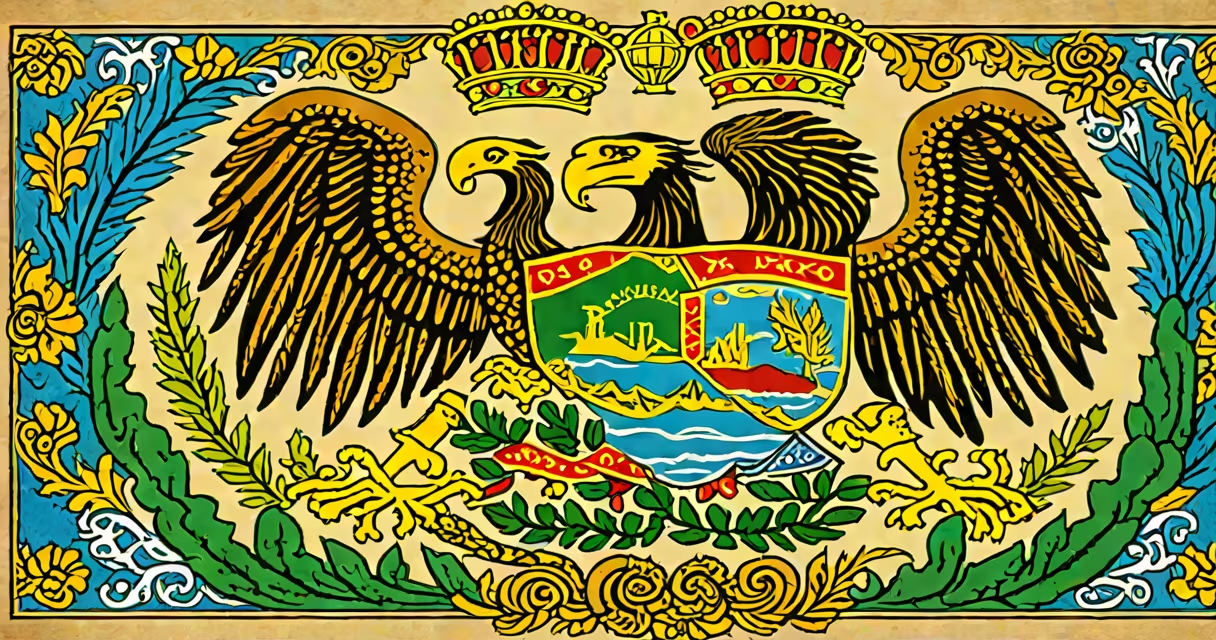
The coat of arms of Mexico depicts an eagle perched on a nopal cactus, clutching a rattlesnake in its talons, set against a backdrop of a mountainous field. This image originates in the founding myth of Tenochtitlán, the capital of the Aztec Empire, and was formally adopted as the national emblem in 1823.
The design reflects a convergence of indigenous Mesoamerican tradition and Spanish colonial influence. The central scene-the eagle eating the snake-is derived from the legend of the Mexica people, who were instructed by their god Huitzilopochtli to build their city where they saw an eagle devouring a serpent while perched on a cactus growing out of a rock. They found this sign on an island in Lake Texcoco, where modern-day Mexico City stands.
Historical records confirm this origin story. According to the Crónica Mexicayotl, written by Fernando de Alva Cortés Ixtlilxóchitl in the early 17th century, the vision was interpreted as divine guidance. The Spanish conquistadors later documented the same narrative during their conquest, reinforcing its role in shaping Mexico's national identity.
The coat of arms is structured around a single, useful visual metaphor. The eagle represents strength, sovereignty, and vigilance-traits associated with imperial power in both European heraldry and Mesoamerican cosmology. The serpent, often linked to wisdom and renewal in ancient cultures, symbolizes the duality of life and death. The act of the eagle consuming the serpent signifies triumph over chaos and evil.
Below the central image, the word "México" appears in bold serif font. The shield itself is bordered by two olive branches and a ribbon inscribed with "Estados Unidos Mexicanos," meaning "United States of Mexico." These elements reflect peace, unity, and federal structure. The olive branches are a classic symbol of peace in Western iconography, while the ribbon ties the emblem to the country's formal name.
A 1921 redesign by the Mexican government standardized the current version. The eagle's posture was adjusted to face left, aligning with traditional heraldic conventions. The cactus is rendered with precise botanical detail-specifically the Nopalea cochenillifera, a species native to central Mexico. This level of accuracy underscores the emblem's commitment to cultural authenticity.
The coat of arms appears in multiple forms depending on context. The most common version is the full national emblem, used on government documents, currency, and public buildings. A simplified variant omits the surrounding text and uses only the central image, typically seen on military insignia and athletic team uniforms.
| Use Case | Design Variant | Key Features |
|---|---|---|
| Government Seal | Full Emblem | Eagle, cactus, snake, olive branches, "México" text, ribbon |
| Currency (peso coins) | Simplified | Central image only, no text or borders |
| Military Insignia | Monochrome | Black-and-white rendering, minimal detail |
| State Government Flags | Modified | Coat of arms centered, often with state-specific colors |
Each variant maintains core symbolic integrity. For example, even on a black-and-white military patch, the eagle's head is oriented toward the viewer's right, preserving the original directionality established in 1921.
The coat of arms of Mexico appears on all official state documents, including passports, driver's licenses, and judicial decrees. It is required on the front cover of every Mexican constitution, as mandated by Article 32 of the 1917 Constitution. The emblem is also displayed on the presidential seal and during national ceremonies such as Independence Day on September 16.
Public spaces reflect its prominence. In Mexico City, the National Palace's main façade features a large mural of the coat of arms. The monument to the Virgin of Guadalupe near the Basilica of Our Lady of Guadalupe includes a smaller version carved into stone. Even street signs in major cities incorporate the emblem in their design.
Internationally, the coat of arms serves as a diplomatic identifier. When Mexico hosts foreign envoys or participates in multilateral summits, the emblem appears on official invitations and briefing materials. The United Nations uses the Mexican flag with the coat of arms in its database of member states.
Many assume the eagle in the coat of arms is a bald eagle. It is not. The bird is a golden eagle (Aquila chrysaetos), which is native to North America and historically revered by various Indigenous groups. The golden eagle's presence in the emblem reinforces its connection to the natural environment and spiritual authority.
Another frequent error is claiming the cactus is a prickly pear. While the plant is a species of Opuntia, the specific cactus shown is the Nopalea cochenillifera, known for its edible pads and red dye-producing insects. This species grows in the Valley of Mexico and was central to the myth of Tenochtitlán's foundation.
Some sources incorrectly attribute the design to the Spanish Crown. The emblem was never part of the Spanish colonial coat of arms. Instead, it emerged during the post-independence period, when Mexico sought to distinguish itself from its former ruler through indigenous imagery. The 1823 adoption was formalized under President Vicente Guerrero, who emphasized national pride rooted in pre-Columbian heritage.
I once stood in the Zócalo, Mexico City's main square, during a national holiday parade. The float representing the Ministry of Foreign Affairs carried a massive, illuminated version of the coat of arms. The eagle's wings spanned nearly four meters, and the snake was animated to writhe slightly as the float moved. The crowd erupted in cheers-not because of the size, but because of the precision in the details: the correct number of feathers on the eagle's wing, the accurate placement of the cactus spines.
This moment confirmed how deeply embedded the emblem is in civic life. It's not merely a historical artifact-it's a living symbol. The design's consistency across decades, despite political changes, speaks to its enduring legitimacy.
The coat of arms of Mexico is more than a national symbol-it is a visual narrative of origin, resistance, and rebirth. Its roots in Aztec mythology, its formal adoption in 1823, and its continued use in government and public life make it one of the most studied emblems in the Americas. Understanding its layers reveals how a single image can unify a nation across centuries.