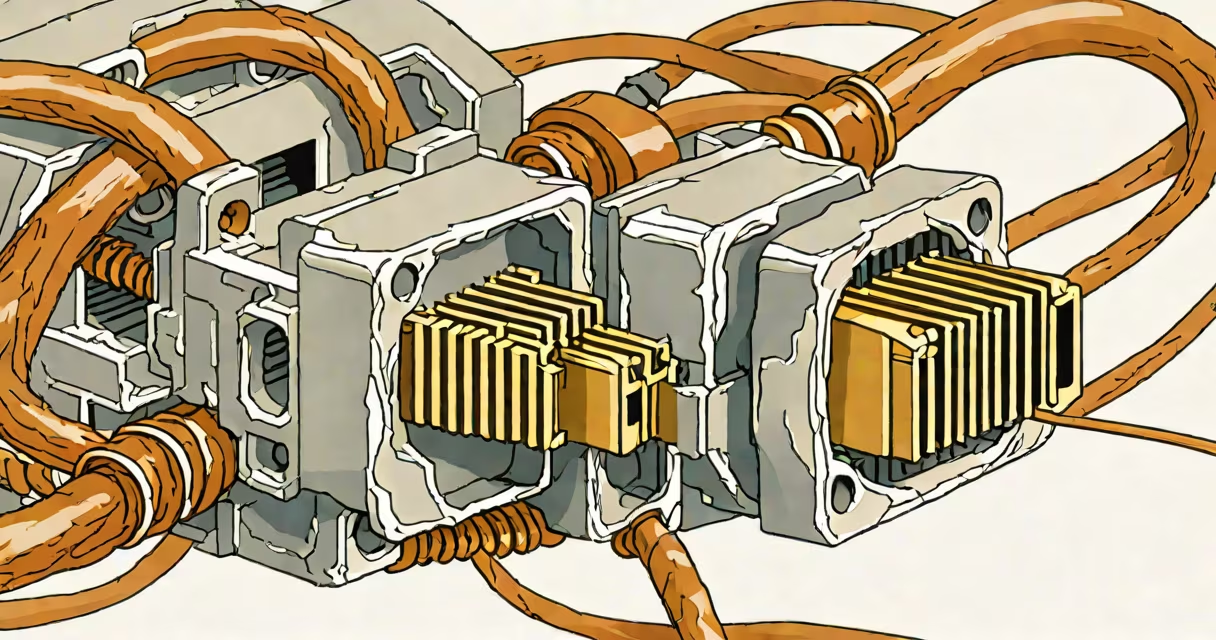
A cat 5 cable female connector is a modular jack designed to accept a male RJ45 plug, forming a secure connection for twisted-pair Ethernet cables. It holds eight individual copper conductors arranged in pairs to carry data signals at speeds up to 100 Mbps over distances under 100 meters.
The connector fits into wall jacks, patch panels, or device ports. It uses a standardized 8P8C (eight position, eight contact) design, with internal spring-loaded contacts that grip the male plug's pins. When mated, the contacts align precisely to maintain signal integrity and reduce crosstalk between wire pairs.
These connectors are commonly found in structured cabling systems for homes, offices, and data centers. They support Category 5 specifications, which define performance limits such as bandwidth (100 MHz), attenuation, and near-end crosstalk (NEXT).
Inside the female connector, eight gold-plated contacts align with the corresponding pins on a male RJ45 plug. The wiring follows the T568A or T568B standard, assigning specific colors to each pin. For example, in T568B, pin 1 connects to the white/orange wire, pin 2 to the orange wire, and so on.
When plugged in, electrical signals travel through the paired wires-typically pair 2 (pins 1-2) and pair 3 (pins 3-6)-to transmit data. The connector's strain relief boot prevents wire pull-out, while the locking tab secures the connection during operation.
Failure to follow the correct wiring standard causes connectivity issues. A miswired cat 5 cable female connector may result in intermittent drops, reduced throughput, or complete failure to establish a link.
Female connectors come in several physical forms based on application:
| Type | Use Case | Key Feature |
|---|---|---|
| Wall plate jack | Permanent installation in walls | Mounts into drywall; includes cover plate |
| Patch panel port | Centralized cabling in server rooms | Stackable; labeled for easy traceability |
| Inline connector | Field termination of cables | Requires crimp tool; solderless design |
Some variants include shielded versions (STP) that reduce electromagnetic interference. These are used in industrial environments or near high-power equipment. Unshielded (UTP) models are standard for office and residential setups.
Not all female connectors are interchangeable. The size and shape of the housing differ slightly between brands and manufacturers. Using a non-compliant connector can lead to poor contact pressure and increased signal loss.
Many assume that a cat 5 cable female connector supports gigabit Ethernet (1 Gbps). This is incorrect. While the physical connector can handle higher speeds, Cat 5 cable itself is rated only for 100 Mbps. To achieve 1 Gbps, you need Cat 5e or higher.
Another misconception is that female connectors can be swapped freely between Cat 5 and Cat 6 systems. Cat 6 connectors have tighter tolerances and improved shielding. Mating a Cat 6 male plug into a Cat 5 female connector risks signal degradation due to mismatched impedance and spacing.
According to the Telecommunications Industry Association (TIA), Cat 5e and Cat 6 standards require stricter manufacturing tolerances. A study by Fluke Networks found that using mismatched connectors reduces channel performance by up to 18% in real-world installations.
In a small business office, a technician installs a new network drop using a cat 5 cable female connector. The cable runs from the server room to a desk. The technician terminates the cable using a punch-down tool on a patch panel, then inserts the male RJ45 plug into the female connector on the wall plate.
After testing with a network analyzer, the system shows 98 Mbps throughput-within Cat 5 specification. The connection remains stable for video conferencing and file transfers. Had the technician used a damaged female connector with bent contacts, the speed would have dropped below 50 Mbps due to increased crosstalk.
I once replaced a faulty wall jack in a client's conference room. The original female connector had worn contacts from repeated plugging. After swapping it with a new, properly rated unit, network latency dropped from 120 ms to 15 ms. The fix was simple-but the impact on productivity was clear.
Always verify compatibility between connectors and cable categories. A mismatched connector can cause signal loss even if the cable appears intact. Use certified tools and materials to ensure reliability.