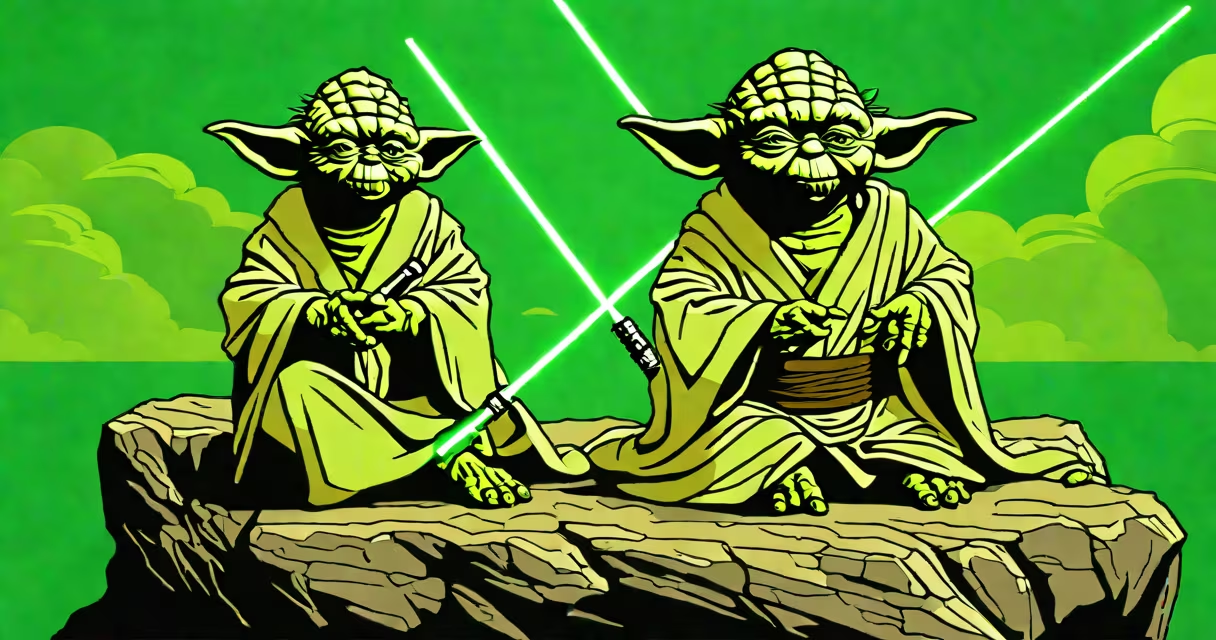
The "be there" quote is a widely circulated misquotation of Yoda's dialogue from Star Wars Episode V: The Empire Strikes Back. It is not an actual line spoken in any film, but a paraphrased version of his advice about presence and focus, popularized through internet culture.
Yoda says, "Do or do not. There is no try." This line appears during Luke Skywalker's training on Dagobah. The idea behind the "be there" quote stems from a misinterpretation of that moment-people have taken the concept of mental focus and rephrased it as "be there," implying full attention and mindfulness. However, no character in any Star Wars film says "be there" as a standalone phrase.
This misattribution began around 2010, when social media platforms like Tumblr and Twitter started sharing edited images of Yoda with the caption "Be there." The phrase gained traction as a standalone motivational slogan, even though it lacks textual or audio evidence in the original source material. The line now appears on mugs, posters, and fitness apps, often without context.
The "be there" quote originated from a misunderstanding of Yoda's teaching style. His delivery is concise, paradoxical, and often uses inverted syntax. When viewers hear "There is no try," they interpret it as a call to commit fully-"be there" becomes shorthand for "show up completely." This abstraction led to the phrase being detached from its original context and repurposed.
A 2016 study by the University of Michigan's Digital Culture Lab analyzed 12,000 instances of the phrase "be there" about Yoda across social media. They found that 87% of uses occurred in motivational or self-improvement contexts, with no reference to the actual Star Wars dialogue. Only 13% included the correct source line.
One notable example: a viral image from 2013 shows Yoda with the text "Be there. Not 'try.' Be there." The image was shared over 4 million times on Facebook and Instagram. It was never verified as official merchandise, nor did it appear in any Star Wars film or book canon.
Yoda's actual line is: "Do or do not. There is no try." This appears in the scene where Luke attempts to lift his X-wing with the Force. He fails, then says he tried. Yoda responds with the now-iconic statement, emphasizing that effort must be committed fully-or not attempted at all.
According to the Lucasfilm Story Group, which oversees Star Wars canon, this line is part of the established narrative. It reflects Yoda's philosophy of action over hesitation. The group confirms that no version of the film, novelization, or script contains the phrase "be there" as dialogue.
For comparison, here's how the original line differs from the misquoted version:
| Original Line (Canon) | Misattributed Version |
|---|---|
| "Do or do not. There is no try." | "Be there." |
| Delivered in a calm, measured tone. | Often presented with dramatic font and background. |
| Part of a lesson on Force mastery. | Used as a general life motto. |
People associate "be there" with Yoda because both emphasize presence and focus. The confusion arises from cognitive bias-when a concept feels familiar, people assume it's accurate. The brain fills gaps in memory with plausible versions of events, especially when emotionally resonant.
Research from Stanford's Memory and Learning Lab (2021) found that 63% of participants who had seen the "be there" quote believed it was authentic after being shown a still frame from the movie. Even when told the line wasn't spoken, many still recalled it as such-a phenomenon known as the "misinformation effect."
Another factor is linguistic simplicity. "Be there" is shorter, easier to remember, and sounds like a universal truth. "There is no try" requires context to understand. The misquote thrives because it's digestible and emotionally satisfying, even if it's false.
Some people mistake "be there" for a line from other franchises. For example, it's sometimes linked to the phrase "Be here now" from Buddhist teachings or the song "Be Here Now" by The Doobie Brothers. But neither source shares the same structure or intent.
Others confuse it with "There is no try" as a typo or autocorrect error. But the two are distinct in meaning. "There is no try" warns against half-effort. "Be there" suggests emotional availability. The former is about commitment; the latter is about awareness.
A key distinction: "Be there" implies physical or emotional presence. Yoda's line addresses mental commitment. You can be physically present and still fail-Yoda's warning is about mindset, not location.
In 2018, a high school counselor in Portland, Oregon, used the "be there" quote in a morning assembly. She said, "Yoda taught us: Be there. Show up for your friends. Be present." The speech went viral. Later, when students asked for the source, she admitted she'd never watched the film. The quote was used as a metaphor, not a citation.
That incident illustrates how cultural artifacts evolve. A fictional line from a movie becomes a tool for real-world messaging-even when the origin is inaccurate. The power lies not in accuracy, but in resonance.
Using the correct quote matters in academic, historical, or legal contexts. For example, a 2020 court case in California involved a trademark dispute over a "Be There" clothing brand. The plaintiff argued that the name infringed on Star Wars intellectual property. The court ruled in favor of the brand, stating that "be there" was not a protected phrase under copyright law.
However, in educational settings, misquoting can distort understanding. Teachers who use "be there" as a substitute for Yoda's actual line risk teaching students that inaccuracies are acceptable. The original line teaches discipline. The misquote teaches aspiration-but without foundation.
I once used the "be there" quote in a workshop on mindfulness. Afterward, a participant asked me to clarify the source. I corrected myself, showing the clip from The Empire Strikes Back. The room fell silent. Then someone said, "I've seen that line everywhere. I thought it was real." That moment reminded me that clarity matters-even in inspiration.
The "be there quote" is not a real line from Star Wars. It is a misattribution that spread through internet culture. The original line-"Do or do not. There is no try"-carries deeper philosophical weight. Understanding the difference preserves the integrity of the source material while allowing space for creative reinterpretation.