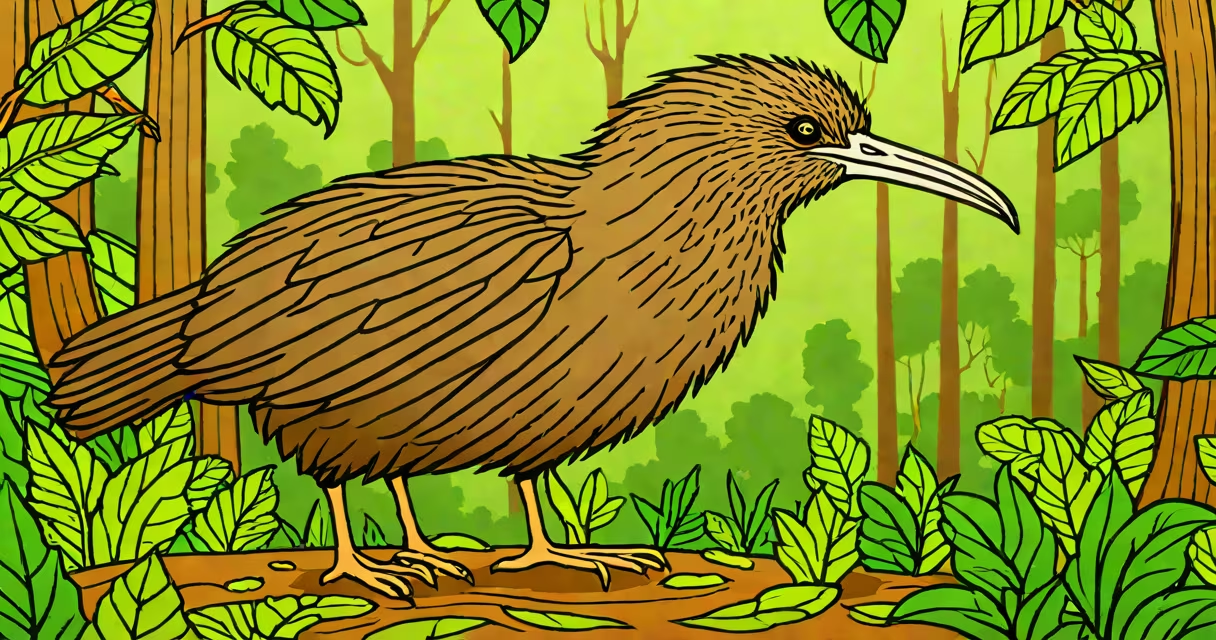
Kiwi birds are real, flightless birds endemic to New Zealand. They belong to the family Apterygidae and are among the most distinctive avian species on Earth, recognized by their long beaks, small wings, and shaggy, hair-like feathers.
These birds evolved in isolation on New Zealand's islands, where they filled ecological niches typically occupied by mammals. Without natural predators before human arrival, kiwis developed traits suited to a ground-dwelling lifestyle-nocturnal behavior, strong legs for digging, and acute hearing and smell to locate food.
There are five extant species of kiwi: the great spotted kiwi, little spotted kiwi, southern brown kiwi, North Island brown kiwi, and the extinct Haast's kiwi. All are endangered due to introduced predators like stoats, ferrets, and domestic cats. Conservation efforts have focused on predator-free sanctuaries and captive breeding programs.
Kiwi birds rely on their sense of smell rather than vision to find food. Unlike most birds, which depend on sight, kiwis use their long, flexible beaks to probe soil and leaf litter for insects, worms, and grubs. The tip of the beak contains sensory pits that detect electrical signals from prey, allowing them to hunt effectively in darkness.
They move slowly and deliberately, using useful legs to dig through soft earth. Their feet have four toes, with the outer toe facing backward-a trait shared with other ratites like ostriches and emus. This foot structure aids in stability and digging, not running.
Reproduction is unusual among birds. Female kiwis lay the largest egg relative to body size of any bird species-up to 20% of her body weight. The egg takes about 80 days to hatch, and the male incubates it almost exclusively. After hatching, the chick is precocial-able to fend for itself within hours.
Five living species of kiwi exist, each adapted to specific regions of New Zealand's North and South Islands. The differences between them are subtle but significant in conservation planning.
| Species | Size | Range | Conservation Status |
|---|---|---|---|
| Great spotted kiwi | Largest (up to 4 kg) | South Island highlands | Endangered |
| Little spotted kiwi | Smallest (1-1.5 kg) | Stewart Island, offshore reserves | Endangered |
| Southern brown kiwi | Medium (2-3 kg) | South Island lowlands | Endangered |
| North Island brown kiwi | Medium (2-3 kg) | North Island forests | Threatened |
| Rowi (Okarito kiwi) | Medium (2-3 kg) | West Coast, South Island | Critically Endangered |
Despite their similar appearance, each species has distinct vocalizations used for territorial defense and mating. Researchers use these calls to track populations without disturbing them.
Many people assume kiwi birds are mythical or fictional because of their unusual features. Their lack of flight, odd beak shape, and nocturnal habits make them seem like creatures from folklore. However, they are well-documented in scientific literature and field studies.
A frequent confusion is equating kiwi birds with the fruit. The fruit, also called kiwi, was named after the bird in the late 19th century due to its fuzzy green skin resembling the bird's plumage. The animal and the fruit share no biological relationship beyond the name.
Another misconception is that kiwi birds are slow or unintelligent. Field observations show they are highly alert and capable of complex behaviors. For example, a study published in Animal Behaviour documented that kiwi birds can recognize individual humans and respond differently based on past interactions-indicating advanced social cognition.
Kiwi birds serve as national symbols of New Zealand. They appear on the country's $1 coin, are featured in Māori legends, and are central to conservation campaigns. The government's Department of Conservation (DOC) runs the "Save Our Kiwi" initiative, which funds habitat restoration and predator control.
One notable project is the Karori Sanctuary (now Zealandia) in Wellington, where a 2.5 km fenced area excludes all introduced predators. Since 2002, over 200 kiwi chicks have been released into the sanctuary. Monitoring shows survival rates exceeding 90%-a dramatic improvement over wild populations.
During a visit to Zealandia in 2022, I observed a great spotted kiwi foraging under cover of dusk. Its beak moved rapidly through leaf litter, and it paused briefly to sniff the air-behavior consistent with reliance on olfaction. The bird vanished into dense undergrowth without a sound, confirming its stealthy nature.
Unlike many birds, kiwi males do not build nests. Instead, they dig shallow burrows in soft soil or beneath logs. The female lays the egg, then leaves the male to incubate it for nearly three months. During this time, he rarely eats or drinks, surviving on stored fat.
Another non-obvious fact: kiwi birds have a single ovary. Most birds have two ovaries, but kiwi females retain only one, which produces a single large egg per breeding cycle. This adaptation reduces energy expenditure and increases offspring survival odds.
According to the International Union for Conservation of Nature (IUCN), all kiwi species are classified as threatened or endangered. The IUCN Red List notes that population declines exceed 50% over the last three generations due to predation and habitat loss. The New Zealand Department of Conservation estimates fewer than 68,000 kiwi remain in the wild.
For comparison, the American bald eagle was once listed as endangered but recovered through legal protection and habitat management. Kiwi conservation faces greater challenges due to the absence of natural predators and the difficulty of eradicating invasive species from remote forests.
Yes, kiwi birds are real. They are not mythological, nor are they a hoax. They are a unique group of flightless birds with evolutionary adaptations shaped by millions of years of isolation. Their existence is confirmed by decades of field research, genetic analysis, and ongoing conservation monitoring.