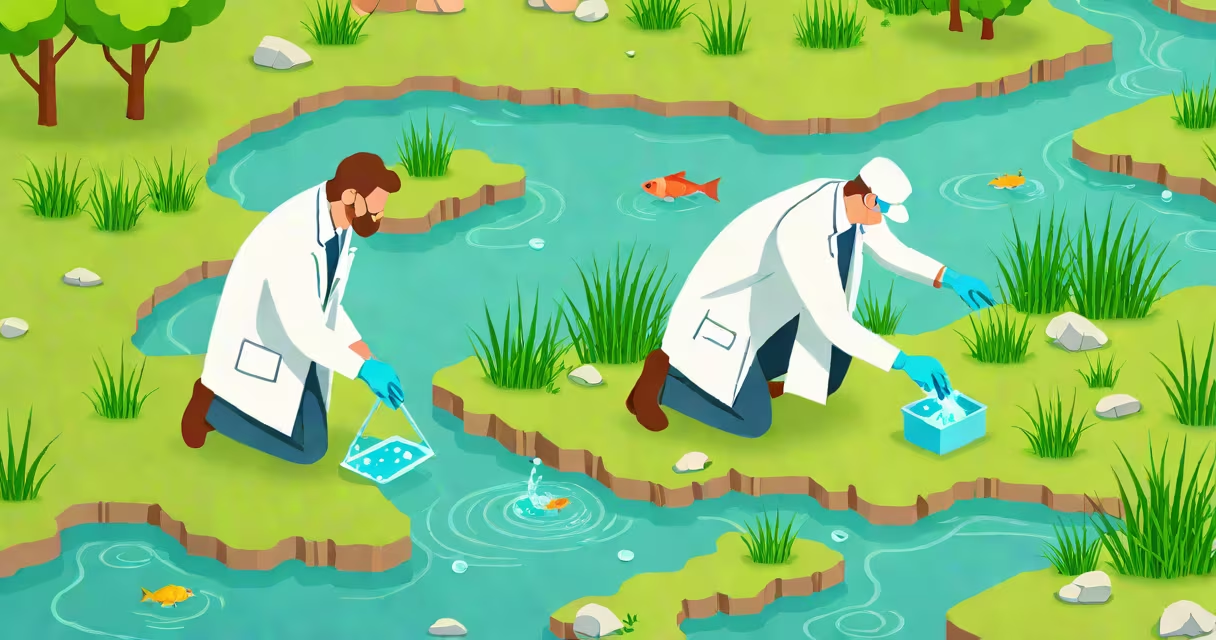
Environmental scientists investigate how human activity and natural processes affect air, water, soil, and living systems. They analyze pollution levels, assess system health, and predict environmental risks to support sustainable policies and conservation strategies.
These professionals combine biology, chemistry, geology, and data analysis to understand complex interactions between humans and their environment. Their findings inform regulations, land-use planning, and climate adaptation measures across governments, nonprofits, and private industries.
For example, an environmental scientist might track pesticide runoff from farmland into nearby streams, measure heavy metal concentrations in urban soil, or model how rising sea levels could impact coastal wetlands by 2050. Their work is grounded in field sampling, laboratory testing, and statistical modeling.
Environmental scientists examine multiple interconnected domains. The most common areas include air quality, water resources, soil contamination, biodiversity loss, and climate change. Each requires specialized tools and methods.
Air quality studies involve measuring pollutants like nitrogen oxides, particulate matter, and volatile organic compounds. Scientists deploy sensors in cities and forests to detect seasonal patterns and correlate them with traffic volume or industrial output. According to the U.S. Environmental Protection Agency (EPA), long-term exposure to PM2.5 particles increases respiratory disease rates by 15% in urban populations.
Water resource assessments focus on surface and groundwater health. Scientists test for nitrates, coliform bacteria, and microplastics. A 2022 study published in *Environmental Science & Technology* found that 60% of freshwater samples from agricultural regions contained detectable levels of neonicotinoid pesticides, which harm aquatic insects and disrupt food webs.
Environmental scientists work across distinct research categories based on goals and methods:
| Type | Focus Area | Common Methods | Example Application |
|---|---|---|---|
| Field Monitoring | Real-time system data collection | Soil sampling, water testing, wildlife surveys | Tracking mercury levels in fish from a contaminated lake |
| Remote Sensing | Field-scale changes using satellite imagery | GIS mapping, spectral analysis, drone imaging | Detecting deforestation in the Amazon rainforest over five years |
| Lab Analysis | Chemical and biological composition testing | Mass spectrometry, PCR, toxicity assays | Identifying carcinogenic compounds in landfill leachate |
| Modeling & Prediction | Futuristic risk assessment and scenario planning | Climate models, population dynamics simulations | Predicting coral bleaching events under warming ocean conditions |
Each method serves different purposes. Field monitoring provides ground-truth data, while remote sensing enables large-area coverage. Lab analysis confirms the presence and concentration of hazardous substances. Modeling allows scientists to project outcomes under various policy or climate scenarios.
Environmental science is often misunderstood as solely focused on nature preservation or climate activism. While advocacy plays a role, the discipline is rooted in empirical science and evidence-based decision-making.
One frequent error is equating environmental scientists with ecologists. Ecologists study species interactions and system dynamics, but environmental scientists integrate those findings with human health, economics, and policy. For instance, an ecologist may document declining bee populations, but an environmental scientist would trace the cause to pesticide use, assess its impact on crop yields, and recommend regulatory changes.
A lesser-known fact: many environmental scientists work in industry, not government or academia. Companies hire them to conduct environmental impact assessments (EIAs) before building factories, pipelines, or housing developments. These assessments are legally required in over 100 countries under international agreements like the Espoo Convention.
In 2010, after the Deepwater Horizon oil spill in the Gulf of Mexico, environmental scientists played a critical role in damage assessment and cleanup coordination. Teams collected sediment and water samples from affected coastlines, analyzed hydrocarbon levels, and tracked the movement of oil slicks using satellite data.
They identified that certain polycyclic aromatic hydrocarbons (PAHs) persisted in marsh soils for over three years, harming marsh grasses and nesting birds. Based on this data, federal agencies adjusted restoration timelines and prioritized areas with high toxicity. The EPA later cited this research as foundational in revising offshore drilling safety standards.
This case illustrates how environmental scientists don't just observe problems-they help define solutions. Their reports influence court rulings, funding allocations, and emergency response protocols.
I once joined a team monitoring lead contamination in urban gardens in Detroit. We sampled soil from 42 backyard plots, tested for lead and cadmium, and mapped hotspots using GPS coordinates. One garden had lead levels 12 times above EPA safety thresholds. We recommended raised beds with clean soil and advised residents to avoid growing root vegetables. This work led to a city-wide program offering free soil testing and remediation grants.
The experience showed me that environmental science isn't abstract-it directly affects community health. A single data point can trigger public action.
Environmental science overlaps with several disciplines but maintains distinct boundaries. Unlike civil engineers, who design infrastructure, environmental scientists evaluate how that infrastructure affects local ecosystems. Civil engineers build storm drains; environmental scientists assess whether those drains increase flooding or carry toxins into rivers.
Similarly, while environmental chemists focus on molecular-level reactions, environmental scientists interpret those results in context. A chemist might identify a compound's breakdown rate in water; an environmental scientist determines whether that breakdown product harms fish larvae or accumulates in the food chain.
Even within environmental science, specialization matters. A specialist in atmospheric chemistry won't typically run wildlife habitat models unless cross-trained. The field demands both breadth and depth.