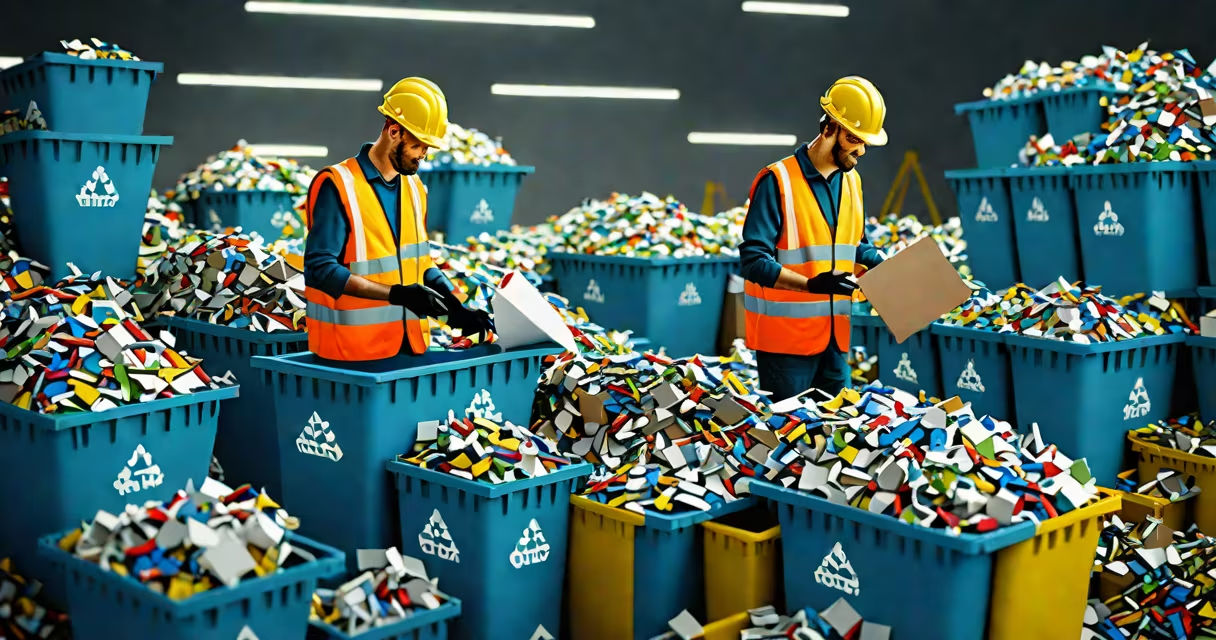
waste and recycling is the systematic collection, processing, and reuse of discarded materials to reduce environmental impact and conserve resources. It turns used items into raw materials for new products, minimizing landfill use and lowering greenhouse gas emissions.
Waste and recycling begins with separation at the source-homes, businesses, and public spaces. Materials like paper, cardboard, plastics, glass, metals, and organic matter are sorted into designated bins. This step prevents contamination, which degrades recyclable quality. For example, food residue on a pizza box reduces its recyclability and increases processing costs.
After collection, materials go to a materials recovery facility (MRF). Here, automated systems such as conveyor belts, optical sorters, and magnets separate streams. Plastic bottles are identified by near-infrared sensors, while aluminum cans are pulled by electromagnets. The sorted materials are then compressed into bales and sold to manufacturers as feedstock.
Not all waste is recycled the same way. The method depends on material composition and market demand. Key categories include:
| Type | Common Examples | Processing Method | End Use |
|---|---|---|---|
| Curbside Recycling | Aluminum cans, clean paper, HDPE plastic (#2) | MRF sorting, baling | New packaging, construction materials |
| Organic Waste | Fruit peels, yard trimmings, food scraps | Composting, anaerobic digestion | Soil amendments, biogas |
| E-Waste | Old phones, computers, TVs | Manual disassembly, shredding, metal extraction | Recovery of gold, copper, rare earth elements |
| Industrial Waste | Scrap metal, plastic offcuts, textile remnants | On-site recycling, bulk transfer | Manufacturing inputs |
One common misconception is that all plastic is recyclable. Only seven resin codes exist, and even then, not all are accepted by local programs. For instance, #3 PVC and #7 mixed plastics often end up in landfills due to limited processing infrastructure. According to the Environmental Protection Agency (EPA), only 9% of U.S. plastic waste was recycled in 2021-over 90% ended up in landfills or incinerators.
Another misunderstanding is that recycling alone solves waste problems. While essential, recycling complements waste prevention and reuse. The EPA defines a hierarchy: reduce, reuse, recycle. A single plastic bottle reused as a planter extends its life beyond one cycle. This principle underpins the circular economy model, where products are designed for longevity and disassembly.
Waste and recycling systems operate globally but vary by region. In Japan, mandatory sorting by 33 categories ensures high recovery rates. Tokyo's system recycles 60% of household waste, far above the U.S. average of 32%. In contrast, low-income nations often lack formal collection networks, leading to open dumping and informal recycling-where children extract metals from e-waste with bare hands.
Environmental benefits are measurable. Recycling one ton of paper saves 17 trees, 7,000 gallons of water, and 4,100 kilowatt-hours of energy. The U.S. recycling industry generates $236 billion annually and supports 560,000 jobs, according to the Institute for Local Self-Reliance.
A personal observation: during a visit to a MRF in Portland, Oregon, I watched a conveyor belt carry 200 pounds of mixed recyclables per minute. Optical scanners detected PET bottles with 98% accuracy. Yet, a single contaminated batch of plastic film caused a shutdown-highlighting how fragile the system is to human error.
Many assume "recyclable" means "recycled." But a label doesn't guarantee processing. In 2022, the FTC updated guidelines requiring brands to prove recyclability in local programs. Labels like "recyclable" without proof mislead consumers and increase contamination.
Another myth: recycling uses more energy than making new products. This is false for most materials. Aluminum recycling uses 95% less energy than primary production. Steel recycling saves 60% energy. The exception is some plastics-especially PET-where energy savings depend on scale and transport distance.
Not all waste can be recycled. Contaminated materials-like greasy pizza boxes or wet paper-must be discarded. The EPA estimates that 25% of curbside recyclables are rejected due to contamination. Proper rinsing and sorting prevent this.
Consider a 12-ounce aluminum can. After being tossed into a blue bin, it's collected by a city truck and delivered to a MRF. At the facility, it passes through a magnetic separator-aluminum is non-magnetic, so it moves freely. Then, a sensor identifies the can's material using spectral analysis. It's then crushed and sent to a shredder.
The shredded aluminum goes to a smelter, where it's melted at 1,220°C. The molten metal is cast into ingots and shipped to a beverage manufacturer. Within 60 days, the ingot is rolled into new cans. The entire cycle-from disposal to reuse-takes about 8 weeks.
This closed-loop system reduces carbon emissions by 95% compared to virgin aluminum production. Over 70% of aluminum ever produced remains in use today, thanks to consistent recycling.
For context, the global recycling rate for aluminum is 70%, higher than any other metal. This success stems from standardized collection, high market value, and efficient processing. In contrast, plastic recycling remains below 10% due to degradation and complex mixtures.
Understanding waste and recycling requires knowing that it's not a single process but a network of decisions, technologies, and behaviors. It's not enough to toss something in a bin. You must know what can be recycled locally, how to prepare it, and why contamination harms the system.
Waste and recycling is a practical response to resource depletion and pollution. It turns waste into value, reduces dependency on raw materials, and lowers environmental damage. With better design, policy, and public awareness, it can become a core part of sustainable living.