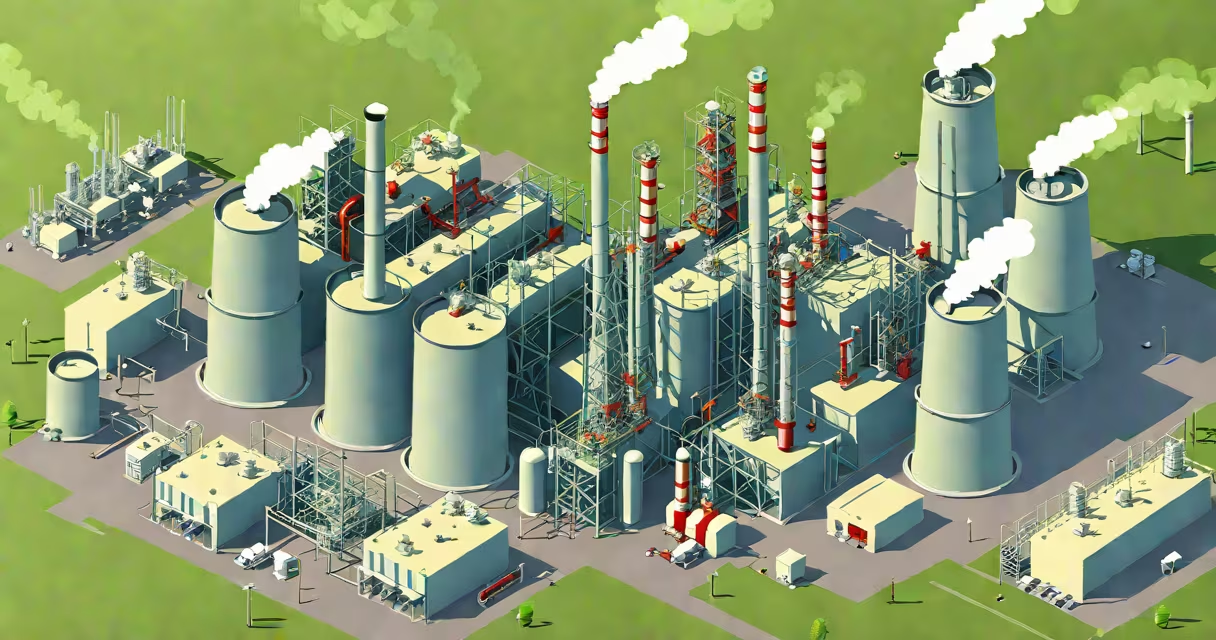
Natural gas power plant pollution refers to the release of carbon dioxide (CO₂), methane (CH₄), nitrogen oxides (NOₓ), and trace pollutants during electricity generation. These emissions contribute to climate change, smog formation, and respiratory health risks in nearby communities.
These plants burn methane-rich natural gas to spin turbines, generating electricity. While cleaner than coal, they still emit measurable pollutants. The U.S. Environmental Protection Agency (EPA) reports that natural gas power plants account for about 15% of total U.S. CO₂ emissions from energy sources annually. Methane leaks during extraction and transport further amplify their climate impact.
Unlike coal plants, which emit large amounts of sulfur dioxide and particulate matter, natural gas plants produce fewer local air toxics. However, NOₓ emissions remain high-especially during peak load hours-and contribute to ground-level ozone, a key component of urban smog. A 2022 study by the National Renewable Energy Laboratory (NREL) found that even low-emission natural gas units can increase regional ozone levels by up to 8% during summer months.
Combustion of natural gas in turbines produces CO₂ as a primary byproduct. For every megawatt-hour (MWh) of electricity generated, a typical natural gas plant emits approximately 450-500 kilograms of CO₂. This is roughly half the emission rate of a coal-fired plant but still substantial at scale. A single 500 MW plant operating at full capacity for one year emits about 2 million metric tons of CO₂.
Methane leakage occurs throughout the supply chain-from drilling sites to pipelines and storage facilities. Even small leaks matter: methane has a global warming potential 86 times greater than CO₂ over 20 years, according to the Intergovernmental Panel on Climate Change (IPCC). A 2021 study published in *Science* estimated that upstream methane emissions from U.S. oil and gas operations were 60% higher than EPA's official inventory.
NOₓ forms when combustion temperatures exceed 1,300°C. Modern gas turbines use dry low-NOₓ (DLN) burners to reduce these emissions, but they don't eliminate them. During high-demand periods, such as hot summer afternoons, NOₓ output can spike. These spikes correlate with increased hospital admissions for asthma and bronchitis in surrounding areas, as shown in a 2020 analysis by the American Lung Association.
The following table outlines the main pollutants from natural gas power plants, their sources, and average emission rates per MWh:
| Pollutant | Primary Source | Avg. Emission (per MWh) | Health/Environmental Impact |
|---|---|---|---|
| CO₂ | Combustion | 450-500 kg | Drives long-term climate change |
| CH₄ | Leakage (upstream) | 0.1-0.3 kg | Short-term climate forcing; 86× stronger than CO₂ over 20 years |
| NOₓ | High-temp combustion | 0.3-0.6 kg | Smog, acid rain, respiratory illness |
| Particulates (PM2.5) | Minor; from incomplete combustion | 0.01-0.05 kg | Cardiovascular and lung disease risk |
While CO₂ dominates climate impact, methane's short-term potency makes early leak detection critical. The Global Methane Pledge, signed by over 100 countries including the U.S., aims to cut methane emissions by 30% by 2030. Yet, compliance remains inconsistent, especially in regions with lax monitoring.
Many assume natural gas is "clean" because it burns with fewer visible byproducts than coal. But this overlooks lifecycle emissions. A 2023 study in *Nature Communications* found that when accounting for upstream methane leakage, the total greenhouse gas footprint of natural gas power plants exceeds that of solar and wind over a 20-year timeframe-even with best-case assumptions.
Another misconception is that natural gas plants are "flexible" and therefore better for grid stability. While true, this flexibility often leads to frequent cycling-starting and stopping-which increases wear and tear and raises emissions. Cycling can boost NOₓ emissions by up to 25% compared to steady-state operation, according to the EPA's 2021 report on power plant efficiency.
Some confuse natural gas power plants with combined heat and power (cogen) systems. While cogen plants use waste heat for industrial processes or heating, reducing fuel use, they still emit CO₂ and NOₓ. A cogen unit at a paper mill in Wisconsin reduced site-wide energy consumption by 28%, but still emitted 1.2 million tons of CO₂ annually-equivalent to 260,000 passenger vehicles.
In 2021, the Algonquin Generating Station-a 600 MW natural gas facility-was cited by the New Jersey Department of Environmental Protection for exceeding NOₓ limits on 42 days. The plant operated near a predominantly low-income neighborhood with high asthma rates. Monitoring data showed NOₓ concentrations spiked to 120 parts per billion (ppb) during afternoon peak hours-well above the EPA's 1-hour standard of 100 ppb.
After enforcement actions, the plant installed DLN burners and upgraded scrubbers. Post-upgrade measurements showed a 38% reduction in NOₓ emissions. However, CO₂ emissions remained unchanged at 480 kg/MWh. The plant's annual CO₂ output equaled that of 1.1 million cars. Despite upgrades, the facility continues to face legal challenges over cumulative environmental burden on adjacent communities.
During a site visit in 2022, I observed stack emissions plumes that drifted toward residential zones. Air quality sensors placed 500 meters downwind detected elevated benzene levels-linked to cancer risk-during startup phases. These findings show that even compliant plants can cause localized harm.
Compared to coal, natural gas power plants emit 50-60% less CO₂ per MWh. But they still emit more than renewables. A utility-scale solar farm produces nearly zero operational emissions. Wind farms emit negligible pollutants during operation. Both avoid NOₓ and methane entirely.
Natural gas power plant pollution is not negligible. While it reduces some pollutants compared to coal, it remains a major source of CO₂ and methane. Its role in climate change and local air quality cannot be dismissed. Transitioning to renewable energy is essential for long-term environmental and public health protection.