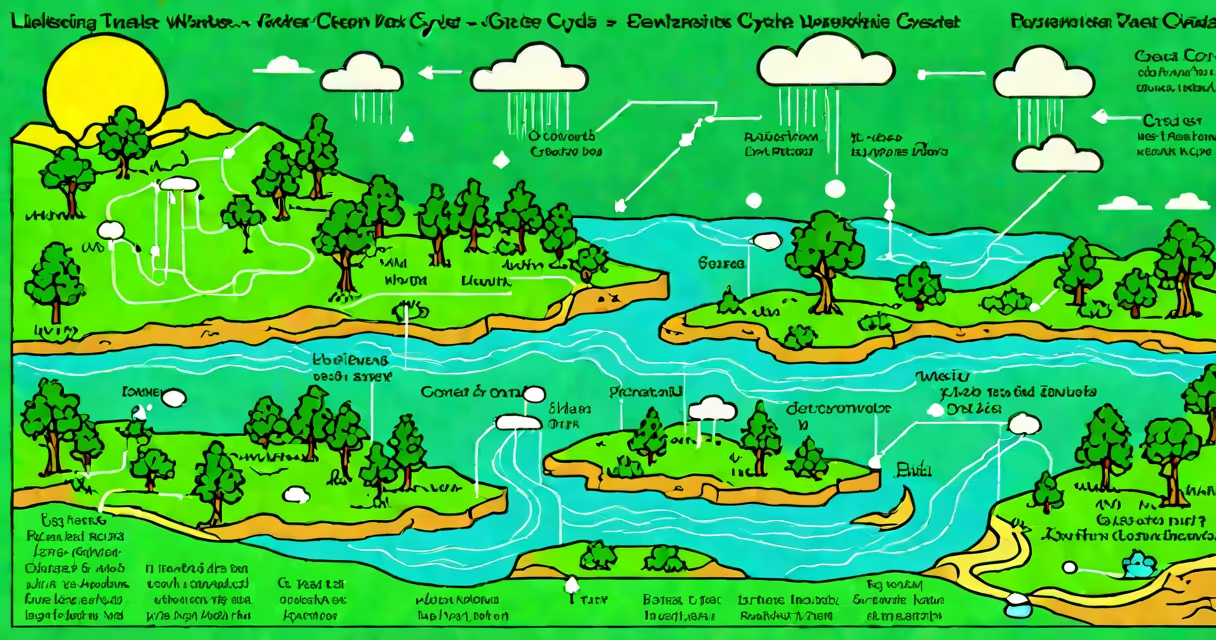
A labeling the water cycle worksheet is a visual learning tool that asks students to identify and name the stages of the water cycle-evaporation, condensation, precipitation, and collection-on a diagram. These worksheets are used in K-6 science classrooms to build foundational understanding of Earth's natural water movement.
Each worksheet presents a simplified diagram of the water cycle, often showing the sun heating water from oceans or lakes, vapor rising into the atmosphere, cooling to form clouds, falling as rain or snow, and returning to bodies of water. Students fill in missing labels using word banks or free recall. The task reinforces both vocabulary and conceptual understanding.
Teachers use these worksheets to assess comprehension, assign homework, or support hands-on experiments like simulating cloud formation with a jar and ice. They align with Next Generation Science Standards (NGSS) for elementary earth science, specifically 5-ESS2-1, which requires students to describe how water moves through Earth's systems.
The worksheet functions as a guided practice exercise. A typical layout shows a circular diagram with arrows indicating direction of flow. Key points are blank or marked with dashed lines, prompting students to write the correct term. For example, a cloud forming above a lake may have a label "condensation" missing.
Some versions include a word bank with terms like "evaporation," "transpiration," "runoff," and "infiltration." This reduces cognitive load and ensures accuracy, especially for younger learners. Others require open-ended responses, testing memory and application.
After completing the worksheet, teachers review answers together. Common errors include confusing "precipitation" with "evaporation" or misplacing "collection" as a standalone stage rather than part of the return phase. Correcting these misconceptions strengthens long-term retention.
Labeling the water cycle worksheets vary by grade level, complexity, and intended use. Below is a comparison of common formats:
| Type | Grade Level | Features | Use Case |
|---|---|---|---|
| Basic Fill-in-the-Blank | Grades 1-3 | Word bank, large labels, minimal text | Introduction to water cycle concepts |
| Advanced Diagram with Labels | Grades 4-6 | No word bank, includes transpiration and infiltration | Assessment or review before tests |
| Interactive Digital Version | All levels | Drag-and-drop labels, instant feedback | Classroom tech integration or remote learning |
One non-obvious distinction: many worksheets omit "transpiration"-the release of water vapor from plant leaves-even though it accounts for about 10% of atmospheric moisture globally. This omission simplifies the model for young learners but can lead to incomplete mental models later. Teachers should clarify this gap during discussion.
Labeling the water cycle worksheet is standard in U.S. public school science curricula. According to the National Science Teaching Association (NSTA), such activities help students visualize abstract processes and improve scientific literacy. The NSTA emphasizes that "hands-on and visual tasks are essential for developing spatial reasoning in early science education."
I once used a labeling the water cycle worksheet with a group of fifth graders during a field trip to a local watershed. After drawing their own version on large poster paper, we compared them to a professional diagram. One student pointed out that "the clouds don't move," which led to a rich conversation about wind patterns and weather systems-something the original worksheet didn't cover but added depth to the lesson.
Students often mix up "condensation" and "precipitation." Condensation is the process of water vapor turning into liquid droplets in the air. Precipitation is when those droplets fall as rain, snow, or hail. A clear example: mist forming on a cold window is condensation. Rain hitting the ground is precipitation.
Another frequent error is placing "collection" as a separate stage rather than part of the return path. In reality, collection includes rivers, lakes, groundwater, and ocean basins-all receiving water from precipitation. Some worksheets incorrectly show collection as a box with arrows pointing inward, implying it's a destination rather than a continuous system.
Correcting these misunderstandings improves accuracy. Research from the American Educational Research Association (AERA) shows that students who receive targeted feedback on diagram labeling tasks score 23% higher on follow-up assessments than those who do not.
Labeling the water cycle worksheet builds more than vocabulary. It introduces systems thinking-the idea that Earth's processes are interconnected. Understanding how water moves between land, air, and sea supports climate literacy and environmental awareness.
For example, a student who correctly labels "evaporation" as the stage where heat turns liquid water into vapor can later connect this to real-world issues like droughts or increased flooding due to climate change. This foundation enables deeper engagement with complex topics in later grades.
When used effectively, labeling the water cycle worksheet becomes a gateway to inquiry. A student might ask, "What happens if the sun stops?" or "Can pollution affect how water cycles?" These questions arise naturally from accurate labeling and lead to richer discussions.
Labeling the water cycle worksheet remains a core instructional method because it makes invisible processes visible. It's not just about naming parts-it's about seeing how nature recycles water across continents, seasons, and lifetimes.