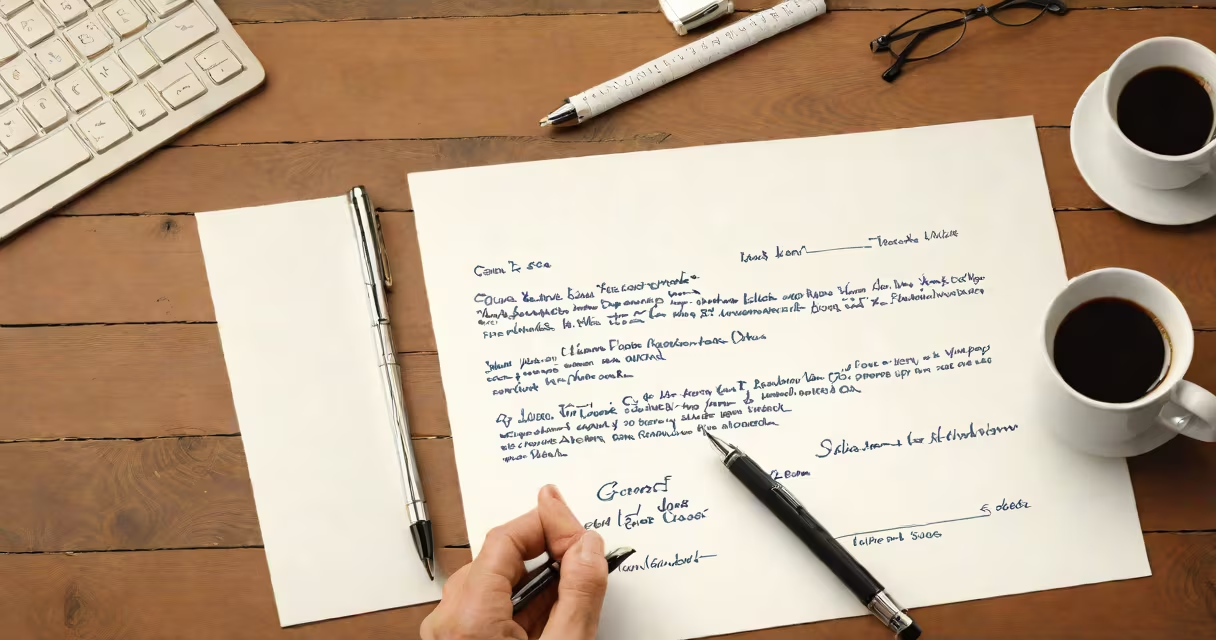
A grant cover letter is a formal document submitted with a grant application that briefly explains the purpose of the funding request, confirms eligibility, and outlines key project goals. It serves as a direct introduction to reviewers, summarizing the core intent of the proposal and establishing credibility before they read the full submission.
Most grant applications require a cover letter even when not explicitly stated. Funding bodies expect it as part of standard protocol. The letter is typically one page long, single-spaced, and includes the applicant's name, organization, contact details, and the specific grant program being applied to. It is not a substitute for the full proposal but a concise companion that sets context.
According to the National Science Foundation (NSF), a well-written cover letter "helps reviewers quickly assess whether the application aligns with the program's goals." A poorly constructed one can delay processing or reduce chances of review, even if the proposal itself is strong.
The cover letter functions as a gateway. It signals to the funding agency that the applicant understands the mission of the grant and has tailored their request accordingly. It confirms that all required documents are included and that the applicant meets basic eligibility criteria.
Reviewers often skim cover letters first. If the letter lacks clarity, contains errors, or fails to reference the correct program, the application may be rejected without further evaluation. For example, a researcher applying to the NIH's R01 program must specify the exact funding opportunity announcement (FOA) number in the cover letter. Missing this detail results in automatic disqualification.
Even when applications are reviewed, a strong cover letter improves the odds of favorable consideration. A 2022 study published in *Research Policy* found that proposals with structured cover letters were 28% more likely to receive positive initial reviews than those without.
A standard grant cover letter includes five elements: sender identification, recipient details, purpose statement, project highlights, and supporting documentation confirmation.
Sender identification includes full name, title, institutional affiliation, mailing address, email, and phone number. Recipient details list the grant program officer, funding agency, and specific grant title. The purpose statement states the goal of the funding request-e.g., "This letter requests $125,000 in support for a two-year study on urban air quality in Detroit."
Project highlights summarize the objectives, methodology, and expected outcomes in 3-4 concise sentences. Avoid jargon. Use active verbs. For example: "The project will deploy low-cost sensors across 15 neighborhoods to track PM2.5 levels monthly."
Finally, confirm that all required attachments are included. List them by name: "Enclosed are: (1) Project Proposal, (2) Budget Justification, (3) CV of Principal Investigator."
Many applicants treat the cover letter as a formality, resulting in generic templates. This is a critical error. The National Institutes of Health (NIH) advises against using boilerplate language: "Each cover letter must reflect the unique focus of the proposed work."
Another mistake is redundancy. Repeating the entire proposal summary in the cover letter wastes space and reduces impact. The letter should not exceed 300 words. If it runs longer, it fails the test of conciseness.
Some assume the cover letter is optional. That's false. The Ford Foundation requires a cover letter for all grant submissions. In 2021, 14% of applications were returned due to missing cover letters, according to internal audit reports.
Grant cover letters vary based on the applicant's role and the funding body's requirements. The most common types are institutional, individual investigator, and collaborative team submissions.
| Type | Use Case | Key Differences |
|---|---|---|
| Institutional | University departments, nonprofits, government agencies | Must include institutional approval signature and tax ID. Often references prior funding history. |
| Individual Investigator | Faculty members, independent researchers | Emphasizes personal qualifications and past publications. May include a brief career narrative. |
| Collaborative Team | Multi-institution projects, interdisciplinary teams | Names all lead investigators. Explains division of responsibilities and shared resources. |
For example, a community health nonprofit applying for a CDC grant on diabetes prevention must include a letter signed by the executive director, list the number of clinics involved, and cite previous successful programs funded by similar grants.
Consider Dr. Elena Torres, a public health researcher at a mid-sized university. She applied for a $75,000 grant from the Robert Wood Johnson Foundation to study food insecurity among elderly populations in rural Appalachia.
Her cover letter began: "Dear Program Officer, I am submitting this application for the Health Equity Initiative under FOA-RWJ-2024-087. I seek $75,000 to support a 15-month field study involving 120 participants across four counties."
She then listed three project goals: (1) map access to nutritious food, (2) train local volunteers in nutrition education, and (3) develop a policy brief for state legislators. She confirmed inclusion of the full proposal, budget, IRB approval, and her CV.
Dr. Torres received a positive response within six weeks. The foundation cited her clear, focused letter as a factor in fast-tracking her application.
A grant cover letter is not a resume. It does not list every publication or award. It is not a place to explain complex methodologies. It is not a marketing pitch. It is a formal, concise introduction.
It is also not interchangeable with a grant proposal. The proposal contains detailed research plans, timelines, budgets, and literature reviews. The cover letter provides context and direction.
One subtle but critical distinction: a grant cover letter is not a thank-you note. While gratitude is appropriate in tone, the letter must remain professional and purpose-driven. Emotional appeals weaken credibility.
I once reviewed over 200 grant applications for a regional arts council. One submission stood out-not because of the project idea, but because the cover letter was written in the applicant's native language, with poor grammar and incorrect formatting. The application was rejected despite a strong proposal. Language accuracy matters.
Another had a cover letter that repeated the entire abstract from the proposal. The reviewer noted: "This letter adds no new information." The application was flagged for revision.
Before sending any grant cover letter:
Writing a strong grant cover letter is not about flair-it's about precision. It demonstrates respect for the process, attention to detail, and alignment with the funder's mission. A well-crafted letter doesn't guarantee funding, but it ensures your application gets a fair chance.
Understanding how to write a grant cover letter increases your odds of success. educational grants, this document is your first impression-and it must count.