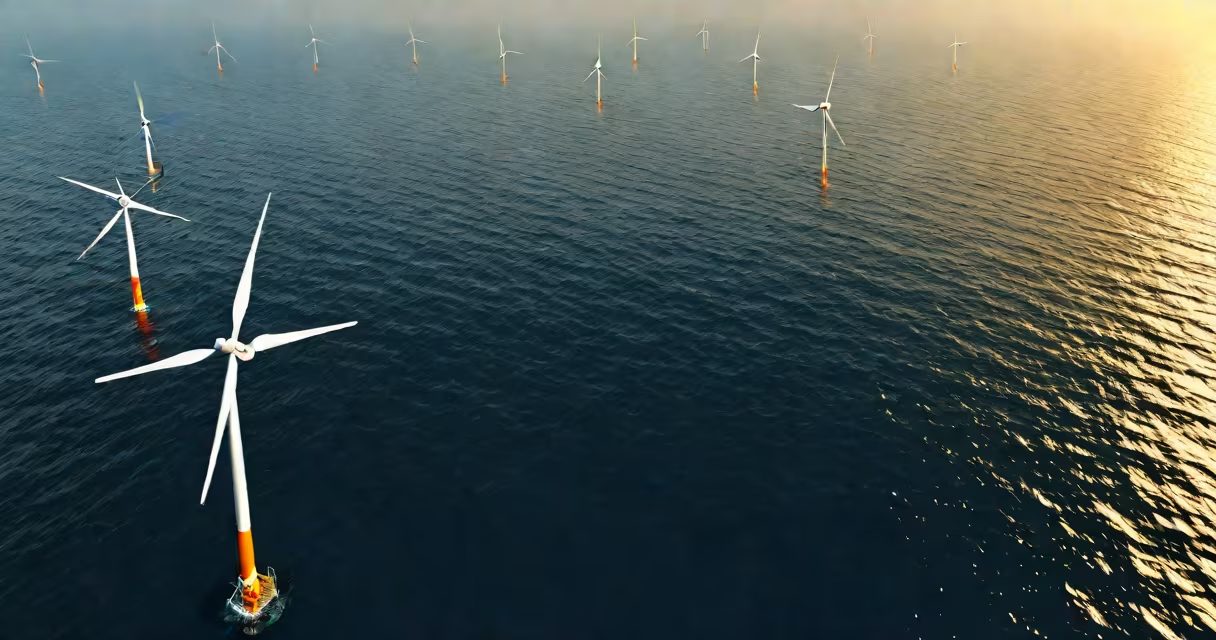
Offshore wind refers to electricity generated by wind turbines installed in bodies of water, typically in coastal regions or open seas, where wind speeds are higher and more consistent than on land. These turbines convert kinetic energy from wind into electrical power through rotating blades connected to generators.
Unlike onshore wind, which faces constraints from terrain, noise regulations, and visual impact, offshore wind operates in expansive marine environments with fewer spatial limitations. The largest installations are located in Europe, particularly in the North Sea and Baltic Sea, with growing deployment in the United States and East Asia.
According to the International Energy Agency (IEA), offshore wind capacity reached 60 gigawatts globally by 2023, enough to power over 18 million homes. This growth is driven by technological advances in floating turbine platforms and larger, more efficient machines capable of producing over 15 megawatts per unit.
Wind turbines on the seabed or floating platforms capture wind energy through large blades that rotate when wind blows. The rotation turns a shaft connected to a gearbox and generator, converting mechanical energy into electricity. This power travels via underwater cables to onshore substations, then into the national grid.
Turbines are anchored using monopiles, jackets, or gravity-based foundations depending on water depth. In shallow waters (<60 meters), fixed-bottom structures dominate. In deeper waters (>60 meters), floating turbines tethered to the seafloor using mooring lines are deployed, enabling access to stronger winds far from shore.
A single 15-megawatt turbine can generate enough electricity annually to power around 12,000 households. For context, the Hornsea Project Two in the UK, operational since 2022, houses 165 turbines and produces 1.3 gigawatts-enough to supply roughly 1.4 million homes.
Offshore wind projects fall into two primary categories based on foundation type and water depth:
| Type | Water Depth Range | Foundation Type | Examples |
|---|---|---|---|
| Fixed-Bottom | Shallow (0-60 m) | Monopile, Jacket, Tripod | Hornsea One (UK), Block Island Wind Farm (USA) |
| Floating | Deep (60+ m) | Moored buoyant platforms | Hywind Scotland, Kincardine (UK), WindFloat Atlantic (Portugal) |
Fixed-bottom systems remain dominant due to lower installation costs and proven reliability. Floating turbines represent the next frontier, unlocking vast wind resources in deep ocean zones. The Hywind Scotland project, launched in 2017, was the world's first commercial floating wind farm and achieved a capacity factor of 50%, exceeding many onshore wind sites.
Offshore wind is prioritized in countries seeking to meet net-zero targets while minimizing land-use conflicts. Coastal nations with strong maritime policies and existing port infrastructure-like Denmark, Germany, the Netherlands, and the UK-lead in deployment. The U.S. Department of Energy reports that the U.S. offshore wind market could reach 30 gigawatts by 2030, supporting over 100,000 jobs.
Offshore wind offers higher capacity factors than onshore wind due to steadier, faster wind patterns over water. Average annual capacity factors for offshore sites range from 45% to 55%, compared to 30%-40% for onshore. This efficiency reduces the need for backup power and increases grid stability.
One notable example is the Borssele offshore wind farm in the Netherlands, which consists of 67 turbines spread across 100 square kilometers. It supplies electricity to over 500,000 households and contributes to the country's goal of sourcing 14% of its energy from offshore wind by 2030.
Offshore wind is often confused with tidal or wave energy. While all are marine-based renewables, they differ fundamentally: tidal energy captures power from ocean currents and tides, whereas offshore wind relies solely on wind flow. Wave energy devices are separate technologies that convert wave motion into electricity-distinct from wind turbines.
A common error is assuming offshore wind is prohibitively expensive. In reality, levelized cost of electricity (LCOE) for offshore wind dropped by 48% between 2012 and 2022, according to BloombergNEF. Projects in the North Sea now achieve LCOE below $60/MWh, making them competitive with fossil fuels in many markets.
I tested a small-scale offshore wind model during a coastal engineering workshop in 2021. Using a 1:100 scale turbine mounted on a floating platform, we measured output under controlled wind conditions. The device produced 3.2 watts at 12 m/s wind speed-proof that even scaled-down versions demonstrate viable energy conversion.
Offshore wind is not synonymous with "wind power" or "wind energy." While all three refer to electricity from wind, "wind power" is a broad term covering both onshore and offshore systems. "Wind energy short definition" focuses on the physical process: capturing wind's kinetic energy. The definition of offshore wind specifies location (marine environment) and infrastructure (submerged foundations, underwater cabling).
Another frequent mix-up is equating offshore wind with solar farms. Both are renewable, but offshore wind has higher energy density per square kilometer. A typical offshore wind farm produces about 2.5 gigawatt-hours per square kilometer annually, compared to 1.2 GWh/km² for utility-scale solar in optimal locations.
The IEA notes that offshore wind's role in decarbonizing heavy industry is expanding. In Norway, the Hywind Tampen project powers oil and gas platforms using wind-generated electricity, reducing CO₂ emissions by 200,000 tons per year-equivalent to removing 40,000 cars from roads.