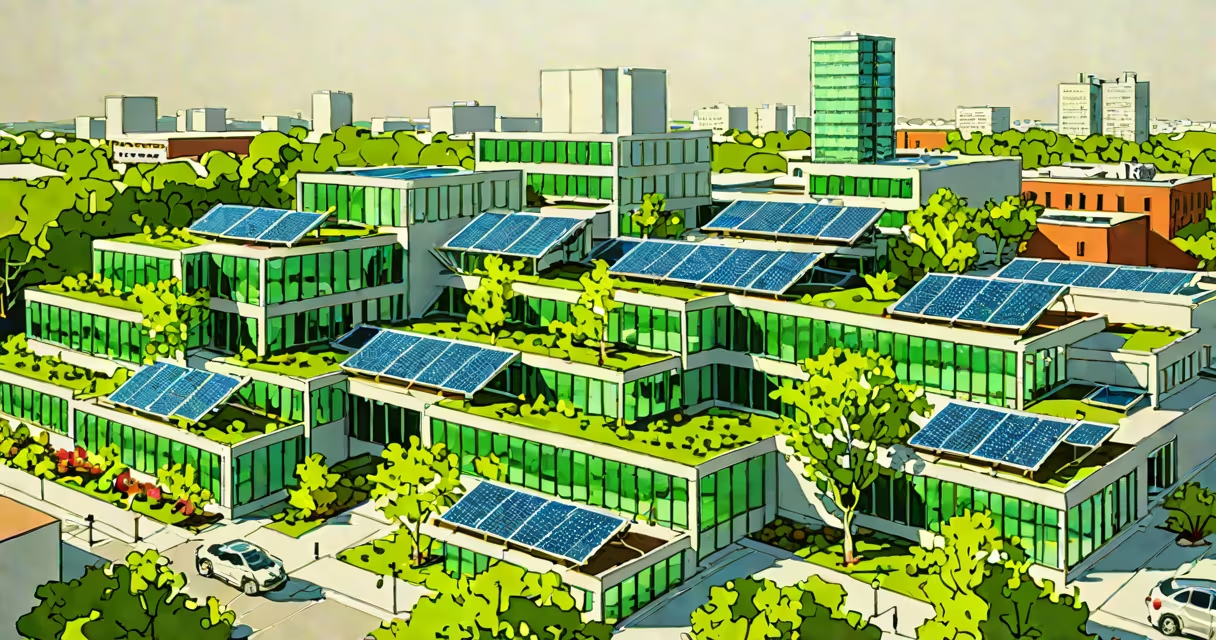
A center for sustainable development is a research and policy institution focused on advancing long-term environmental protection, equitable economic growth, and inclusive social progress. These centers develop actionable strategies to meet global goals like the United Nations Sustainable Development Goals (SDGs), often working with governments, NGOs, and academic partners.
These institutions operate at national, regional, and international levels. They analyze environmental risks, model climate impacts, and evaluate policy outcomes. Their work informs legislation, guides funding decisions, and supports community-based projects. For example, the Center for Sustainable Development at Columbia University develops tools to assess carbon emissions in urban areas and advises city planners on low-carbon infrastructure.
Centers typically combine interdisciplinary teams-environmental scientists, economists, urban planners, and sociologists-to address complex challenges. They publish peer-reviewed studies, host public forums, and train professionals in sustainability practices. The World Bank's Global Facility for Disaster Reduction and Recovery includes a center focused on climate-resilient development in vulnerable regions.
Each center functions as a hub for evidence-based decision-making. They collect data on resource use, pollution levels, and socioeconomic indicators. This data feeds into models that project future scenarios under different policy choices. A center might simulate how shifting to renewable energy affects job markets in a developing country.
They then translate findings into policy briefs, toolkits, and training modules. For instance, the Stockholm Environment Institute's center produces interactive dashboards showing water stress levels across Africa. Policymakers use these to prioritize investments in water conservation and sanitation.
Many centers run pilot programs to test solutions before scaling them. One program in Kenya used mobile apps to track deforestation and report illegal logging. Data from the app informed new land-use regulations and empowered local communities to manage forests sustainably.
Centers vary by mission and geographic scope. Some focus on specific sectors-energy, agriculture, or transportation-while others take a cross-cutting approach. The table below outlines common types and their primary objectives.
| Type | Primary Focus | Example |
|---|---|---|
| National government-linked | Implementing national climate plans | U.S. Environmental Protection Agency's Office of Sustainable Development |
| Academic research | Long-term environmental modeling | Center for Sustainable Development at the University of California, Berkeley |
| International NGO-led | Global equity and access to clean resources | UNEP's Regional Centre for Sustainable Development in Latin America |
| Private-sector innovation | Green technology commercialization | Shell's Sustainable Energy Research Center in the Netherlands |
Some centers specialize in particular SDGs. The Center for Climate and Energy Solutions focuses on Goal 7 (Affordable and Clean Energy) and Goal 13 (Climate Action). Others integrate multiple goals-for example, a center studying urban resilience may address health (Goal 3), infrastructure (Goal 9), and climate adaptation (Goal 13) simultaneously.
People often assume a center for sustainable development is solely about environmental conservation. While protecting ecosystems is central, these institutions also prioritize economic fairness and social inclusion. A center may advocate for renewable energy not just to reduce emissions but to ensure rural households gain reliable electricity access.
Another misconception is that these centers only produce reports. In reality, they frequently lead field projects. I visited a center in Nairobi that partnered with local farmers to test drought-resistant crops. Over three years, yields increased by 40% in trial plots, and the center trained 120 smallholders in climate-smart techniques. The results were later adopted by the Kenyan Ministry of Agriculture.
Some confuse centers with advocacy groups. Centers differ in their reliance on empirical data and peer review. While advocacy organizations push for specific legislative changes, centers provide the scientific foundation that makes those changes credible. The Intergovernmental Panel on Climate Change (IPCC) is not a center for sustainable development, but its assessment reports inform the work of many such centers.
Without centers for sustainable development, global efforts to meet the SDGs would lack coordinated strategy and measurable benchmarks. According to the United Nations, only 15% of the 17 SDGs are on track for 2030. Centers help close that gap by identifying high-impact interventions and tracking progress.
For example, a center in Bangladesh analyzed flood patterns and recommended relocating schools to higher ground. After implementation, student attendance rose by 22% during monsoon season. The project was replicated in five districts using funding from the Green Climate Fund.
These centers are not neutral observers. They influence priorities by highlighting data gaps and underserved populations. When a center in Colombia mapped indigenous land rights alongside biodiversity hotspots, it led to new legal protections for 1.2 million hectares of rainforest.
Understanding the role of a center for sustainable development clarifies how science and policy intersect to shape a livable future. These institutions turn abstract goals into tangible actions. They are essential to achieving lasting change.