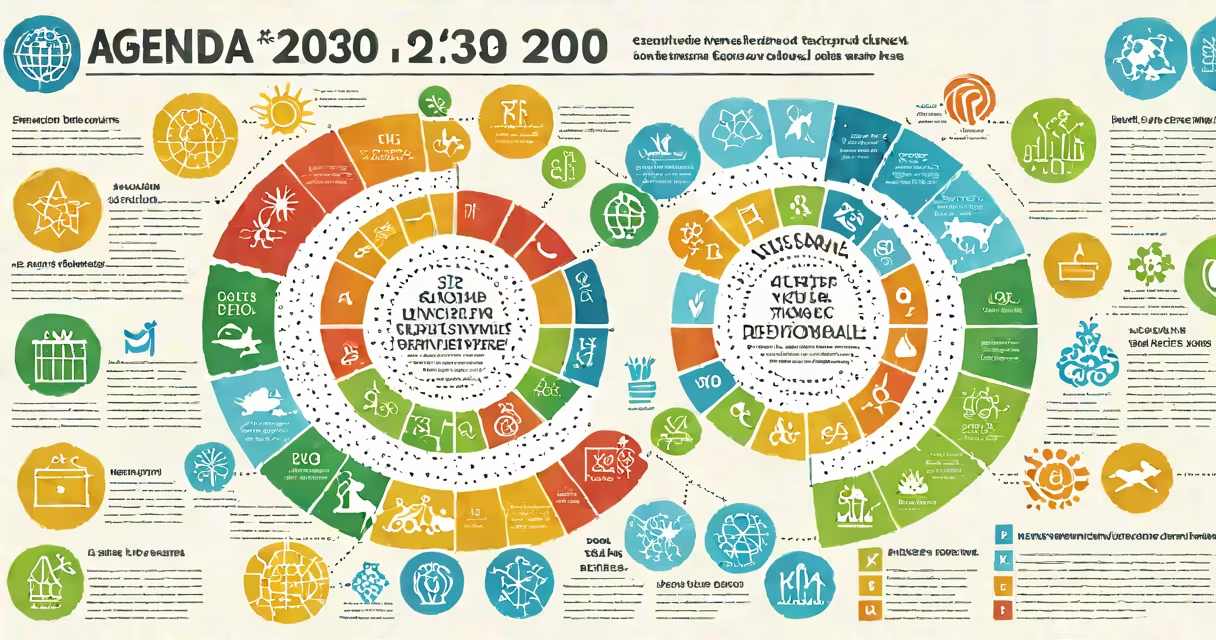
The 2030 Agenda for Sustainable Development is a United Nations resolution adopted in 2015 that sets out 17 interconnected goals to end poverty, protect the environment, and ensure peace and prosperity for all people by 2030. It serves as a global blueprint for action across economic, social, and environmental dimensions.
Adopted by 193 member states, the agenda builds on earlier development frameworks like the Millennium Development Goals. Unlike past efforts, it applies universally-not just to low-income countries-but to all nations, regardless of economic status. The document emphasizes integration: success in one goal often depends on progress in others.
For example, improving access to clean water (Goal 6) supports better health outcomes (Goal 3), reduces gender inequality (Goal 5), and enables education (Goal 4). This interdependence is central to the agenda's design. The UN reports that 129 countries have integrated the SDGs into national planning processes, demonstrating widespread institutional adoption.
Each of the 17 goals includes specific targets-169 in total-and indicators to measure progress. Governments, civil society, and private sector actors use these metrics to track performance annually. Data is collected through national statistical offices and reported via the UN's High-Level Political Forum on Sustainable Development.
Progress is monitored using standardized indicators. For instance, Goal 1 (No Poverty) tracks the percentage of people living below the international poverty line ($2.15 per day). In 2022, 8.5% of the global population lived in extreme poverty, according to the World Bank. That figure rose during the pandemic but has since declined slightly.
When a country fails to meet a target, it may revise policies or allocate additional funding. The European Union, for example, revised its climate strategy in 2023 after assessments showed lagging progress on renewable energy adoption (Goal 7).
The agenda consists of 17 goals, grouped into three broad categories: people, planet, and prosperity. These reflect the triple bottom line of sustainable development-economic growth, environmental protection, and social inclusion.
| Category | Goals | Focus Areas |
|---|---|---|
| People | 1-8 | Poverty reduction, health, education, gender equality, clean water, sanitation, decent work |
| Planet | 9-15 | Climate action, responsible consumption, biodiversity, sustainable cities, oceans |
| Prosperity | 16-17 | Peaceful societies, strong institutions, partnerships for goals |
Goal 13, Climate Action, requires countries to reduce greenhouse gas emissions by at least 45% from 2010 levels by 2030 to limit warming to 1.5°C. The Intergovernmental Panel on Climate Change (IPCC) confirms that current national pledges fall short of this threshold, leaving a gap of 12 gigatons of CO₂ equivalent annually.
One non-obvious point: the agenda does not mandate binding legal obligations. Countries commit voluntarily. This flexibility allows adaptation to local contexts but limits enforcement. A 2021 study by the Overseas Development Institute found that only 38% of national SDG plans included measurable budget allocations, indicating weak financial integration.
Nations apply the agenda in policy design, budgeting, and monitoring. India's National SDG Index tracks progress across states, with Kerala ranking highest in 2023 due to investments in healthcare and education. In contrast, Nigeria ranked lowest, citing challenges in infrastructure and data collection.
Private companies use the agenda to align sustainability reporting. Unilever's 2023 Sustainable Living Report tied product innovation to Goals 12 (Responsible Consumption) and 13 (Climate Action). The company reduced plastic packaging by 50% between 2018 and 2023, contributing to Goal 12.3, which aims to halve global food waste by 2030.
Non-governmental organizations integrate the agenda into advocacy. Greenpeace uses Goal 14 (Life Below Water) to campaign against deep-sea mining. In 2022, they successfully lobbied the International Seabed Authority to delay exploration licenses in the Pacific Ocean.
Many assume Agenda 2030 is a new treaty. It is not. It is a political declaration, not a legally binding agreement. The UN General Assembly adopted it through Resolution 70/1, which calls for voluntary implementation. This distinction matters-countries cannot be fined for missing targets.
Another misconception: the agenda applies only to developing nations. In reality, high-income countries face equal pressure. The United States, for example, scored below average on Goal 12 (Responsible Consumption) due to high per capita resource use. Americans consume 12 times more resources than the global average, according to the Global Footprint Network.
A third error: that all goals are equally urgent. They are not. The UN identifies "major" goals-those with cross-cutting impacts-that require accelerated action. Goal 13 (Climate Action) and Goal 1 (No Poverty) are classified as such because climate change disproportionately affects poor communities. A 2022 report by the UN Development Programme found that 80% of climate-related displacement occurred in low-income regions.
Rwanda implemented a national SDG dashboard in 2018. The system aggregates data from ministries, local governments, and NGOs. By 2023, the country achieved 90% coverage of primary education (Goal 4), with girls' enrollment at 52%-above the regional average.
On Goal 11 (Sustainable Cities), Kigali expanded its public transport network, reducing vehicle emissions by 28% between 2019 and 2022. The city also banned single-use plastics, a move aligned with Goal 12.
However, progress on Goal 15 (Life on Land) stalled. Deforestation rates increased by 1.2% annually due to agricultural expansion. The government responded by launching a reforestation program targeting 1 million trees by 2025.
I visited Kigali in 2023 and saw community-led tree planting events in neighborhoods like Nyamirambo. Volunteers used mobile apps to log plantings, feeding data into the national dashboard. This blend of grassroots effort and digital tracking exemplifies how the agenda functions in practice.
Agenda 2030 explained is not a static list. It is a living structure updated through global reviews. The next major assessment occurs in 2026, with interim reports every two years. Countries submit progress updates to the UN, which synthesizes them into a global report.